
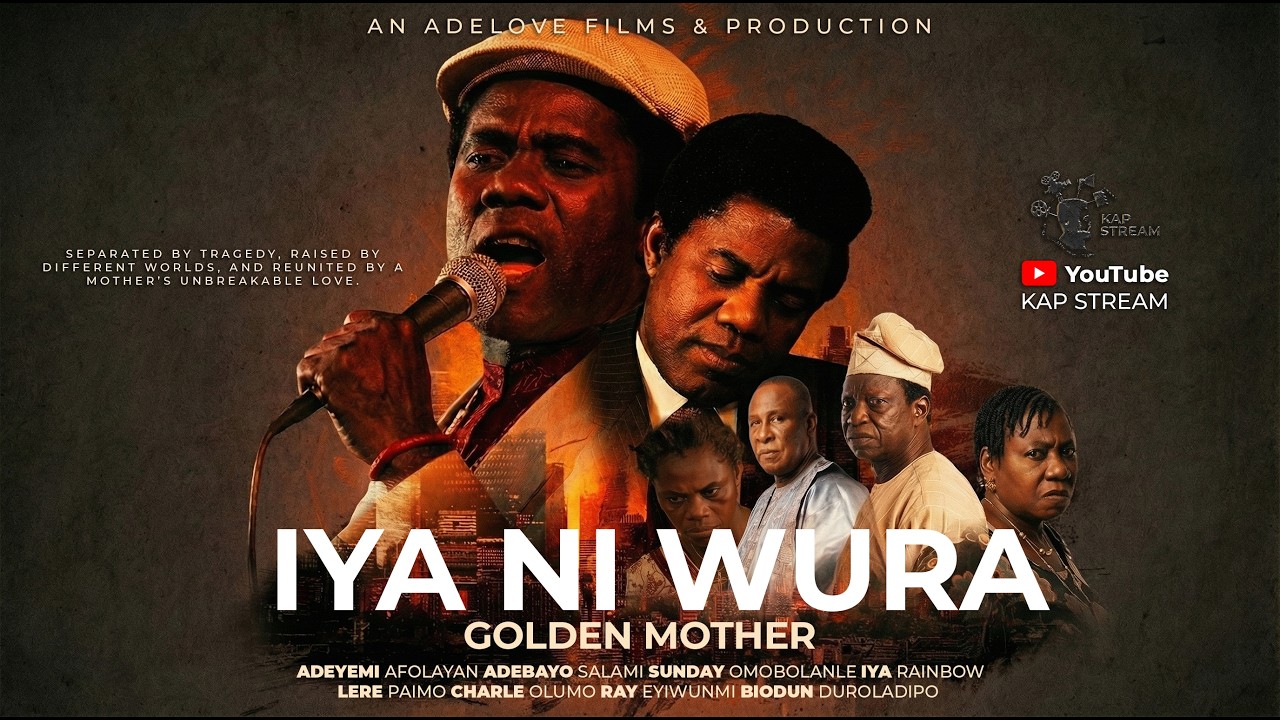
Certain cinematic works possess an enduring quality, transcending their release era to speak to contemporary audiences. This is particularly true when a film effectively documents and reflects societal changes or anticipates future trends. Adeyemi Afolayan's (Ade Love) 1984 film, "Iya Ni Wura," stands as a prime example, functioning as a powerful testament to cinema's role in capturing and commenting on time.
"Iya Ni Wura" was a comprehensive project for Ade Love, who served as writer, producer, director, and lead actor. The narrative centers on twin brothers, Goodluck and Adewale, who are separated as children during a market incident when their mother leaves them briefly. Goodluck is discovered and raised in an orphanage, eventually becoming a music sensation, while Adewale follows in their late father's footsteps to become a lawyer.
While Adeyemi Afolayan's skillful portrayal of both twin brothers is noteworthy, the film's deeper significance lies in its exploration of time – how certain aspects of life evolve while others remain constant. Examining "Iya Ni Wura" reveals several profound observations about the passage of time.
Time as a Chronicler
Films possess a unique capacity for documentation, allowing for comparisons between past realities and present circumstances. "Iya Ni Wura" serves as a historical record of Lagos in the 1980s, showcasing fashion, societal norms, and linguistic patterns of the era. The film depicts a Social Welfare Department actively involved in assisting children found alone, a scenario that might unfold differently today. This highlights how aspects once commonplace have transitioned into historical artifacts.
The Cyclical Nature of Life
Despite the changes wrought by time, certain fundamental aspects of life persist in a cyclical fashion, with traditions and values being passed down through generations. In the 1980s, the Nigerian music industry, while featuring popular artists, lacked the global reach and infrastructure seen today. An artist could now gain international fame from a bedroom recording. However, "Iya Ni Wura" illustrates a timeless dynamic within the music business. Goodluck, also known as King, is affiliated with Fuja Records, managed by Chairman (portrayed by the esteemed Lere Paimo). Upon his contract's conclusion, Goodluck opts for independence, a trend that has become a hallmark of the modern music industry.
Shifting Eras and Their Impact
One of the most striking revelations in "Iya Ni Wura" is how different eras transform individuals. Many characters who appear youthful in the film are now elderly, and some are sadly no longer with us. Observing Moji Afolayan among the orphans in the orphanage prompts reflection on how time alters appearances. Similarly, Adebayo Salami, who plays Goodluck's manager, appears remarkably young, hinting at the natural progression and turnover of talent as Nollywood continues to develop across different periods. "Life na turn by turn," as the saying goes.
"Iya Ni Wura," despite its age, offers a viewing experience that feels remarkably contemporary due to its insightful portrayal of Nigerian society and the passage of time.
Comments (0)
You must be logged in to comment.
Be the first to comment on this article!