
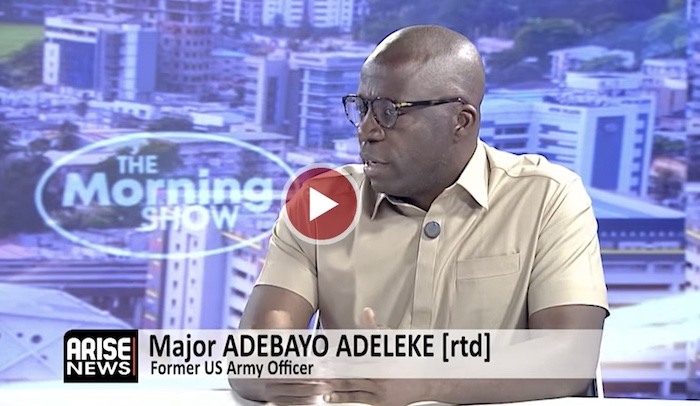
Former US Army officer, Adebayo Adeleke, has stated that President Donald Trump appears indifferent to the international ramifications of the ongoing confrontation with Iran, asserting that the war is already precipitating considerable economic and geopolitical instability across the globe.
During an interview on ARISE News, Adeleke directly commented, “I don’t think he really cares about it,” adding that the US President’s primary objective is to diminish Iran’s power, irrespective of the ensuing effects.
"He really wants to kind of handicap Iran rather because over the last 40 plus years, we’ve been kind of containing them,” he remarked.
Adeleke pointed out that the current approach represents a substantial departure from established US military doctrine, which traditionally favoured managing relations with major global players like Iran, China, Russia, and North Korea to avert widespread repercussions.
"There’s a reason why we kind of manage these things… because any conflict today, we have far-reaching consequences,” he explained. “So this is a clear departure from what a lot of officers… have learned in school.”
He further suggested that US strategists may have underestimated the scale and impact of the conflict.
"I think they underestimated how influential this particular war is and how far-reaching those actions have been,” he said.
Adeleke indicated that the consequences are already evident worldwide, noting disruptions to supply chains and increases in fuel prices and inflation impacting various regions.
“Everybody’s feeling the pinch right now, Americans mostly… the Asians, everybody’s feeling it,” he observed.
He elaborated on how the crisis highlights the critical importance of energy routes and logistical networks within the global economy.
“Whoever controls the energy route controls the supply chain,” Adeleke stated. “Everything runs on logistics… air, maritime, ground, everything runs on fuel prices.”
Regarding broader geopolitical implications, Adeleke dismissed the idea of moral considerations in international conflicts, characterizing them as driven solely by national interests.
“In geopolitics… there’s no bully… it’s a game of power, interest, and survival… morals doesn’t have even say so in it,” he commented.
“It’s an issue of what is American interest and Israel interest… world powers always protect their interests at all costs.”
Despite historical criticism of US military interventions, Adeleke contended that Washington views past conflicts not as failures but as valuable learning experiences.
“We don’t look at this war as failures. We look at it as a different way of fighting,” he stated. “There’s a huge… base in America that is dedicated to lesson-learning war.”
The retired officer also cautioned that internal dynamics within the US military, including leadership changes and reported interference in promotion processes, could potentially undermine morale and operational effectiveness.
“If this thing persists, you’ll see a mass exodus of officers… and it’s going to hurt the US military,” he warned.
Turning his attention to Africa, Adeleke explained that US engagement in Nigeria is primarily motivated by counterterrorism efforts and long-term strategic interests linked to global trade and resource access.
“Strictly… is for counterterrorism purposes,” he said. “If Nigeria’s situation is not fixed… America… will not be able to project power because it needs resources from Africa.”
He emphasized that US personnel operating in Nigeria function in an advisory capacity, respecting Nigeria’s sovereignty.
“Americans that are here… are in the capacity of advisory… Nigeria is still a sovereign nation,” he affirmed.
Addressing Nigeria’s security challenges, Adeleke acknowledged the situation's complexity and advised against expecting swift resolutions.
“We want immediate intervention… but it doesn’t work that way,” he noted. “The complexities in security architecture of Nigeria is just complex.”
He further added, “They can only advise… the person you’re advising can take the advice or ignore it.”
While recognizing the existence of setbacks and uncertainties, Adeleke expressed a degree of cautious optimism.
“I think better days are ahead… but it will take some time,” he projected.
The former officer, who served 20 years in the US Army, reflected on his military tenure as a formative experience.
“I came in as a young boy… I left as a man,” he said. “The US military built so much attributes in me.”
Currently collaborating with Nigerian defence organizations, he stated his dedication to contributing to national security enhancements.
“I’ve been able to help in shaping the forces… and great times are ahead,” he concluded.
Comments (0)
You must be logged in to comment.
Be the first to comment on this article!