
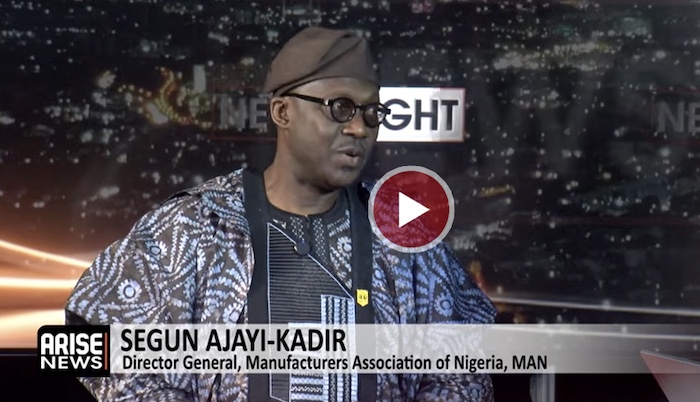
Segun Ajayi-Kadir, the Director-General of the Manufacturers Association of Nigeria (MAN), has expressed optimism about the Federal Government's recently introduced National Industrial Policy, noting that it has the potential to double the manufacturing sector's contribution to the country’s GDP within a decade.
In an interview with Arise News on Tuesday, Ajayi-Kadir indicated that the new policy distinguishes itself from earlier iterations due to its collaborative development with stakeholders and the presence of a detailed implementation plan.
"You can gauge the prospects of a policy by examining its foundation. We have developed this industrial policy together," he stated.
He highlighted that the Minister of Industry, Trade and Investment made a concerted effort to involve manufacturers and other relevant stakeholders in the drafting process.
"The Minister was intentional in involving us in shaping this policy," he explained. "We engaged a diverse mix of stakeholders, spanning beyond MAN to include various development partners and government agencies, illustrating a collaborative governmental approach."
Ajayi-Kadir emphasized that a significant improvement in this policy compared to previous ones is its comprehensive implementation framework.
"What sets this policy apart is its accompanying implementation plan, which outlines specific timelines, responsibilities, and, importantly, criteria for success from the outset," he added.
He revealed that the policy is designed to substantially increase the industrial sector's share of Nigeria's GDP over a ten-year horizon.
"The aim is to elevate the manufacturing contribution from the current 9-10% to as high as 20-25% within this decade," he noted.
He also pointed out that the establishment of an Industrial Revolution Working Group by the Minister has bolstered confidence in the policy’s structure.
"The creation of the Industrial Revolution Working Group by the Honourable Minister has greatly instilled confidence in us, demonstrating that there is a holistic structure in place to ensure its success. This is a distinct improvement over previous efforts," he remarked.
Regarding sectors that will drive industrial growth, Ajayi-Kadir asserted that the policy clearly delineates the industrial sector's scope.
"Manufacturing is critical," he remarked. "The policy specifically identifies the industrial sector's components, highlighting manufacturing, oil and gas, construction, and mining."
He explained that government incentives and financing will be strategically allocated to these targeted sectors.
"The government's main focus will be on directing resources such as incentives, financial support, infrastructure needs, and requirements for integrating into the global economy toward these sectors."
While acknowledging his own bias, he stressed the pivotal role of manufacturing.
"We see the manufacturing sector as crucial in this initiative, and we are looking to leverage existing bilateral and multilateral agreements to boost its growth," he added. "I express a degree of bias in believing manufacturing holds significant promise for this industrial revolution."
He highlighted the food and beverage sector as a particularly promising area for growth.
"For instance, the food and beverage industry has demonstrated great potential, as sustenance is a fundamental need. We must capitalize on our population and the unique advantages of Nigeria's resources," he stated.
Ajayi-Kadir underscored the significance of innovation and technology in promoting industrial growth.
"We are prioritizing innovation and technology to enhance our manufacturing processes. The youth have made remarkable progress in utilizing technology and AI for raw material sourcing and understanding market access in various economies," he noted.
Addressing the important issue of infrastructure, particularly electricity, Ajayi-Kadir termed power as essential for industrialization.
"Power is the lifeblood of industrialization," he asserted. "Although numerous government initiatives have aimed to tackle power supply issues, we have yet to achieve substantial success."
Nonetheless, he mentioned that the new policy incorporates specific energy solutions within its implementation framework.
"The Honourable Minister of State has convened an inter-ministerial meeting that included funders, development finance institutions, the private sector, and various government bodies to address the power supply challenges," he explained.
He disclosed that the Idu Industrial Area is being utilized as a pilot project to test a blended energy model.
"We are using the Idu Industrial Area as a case study to explore various energy sources, including the national grid and renewable energy. The policy aims to replicate this success in other regions so that during this period of industrial revival, we can ensure reliable power in industrial hubs," he elaborated.
He affirmed that roles and responsibilities among various ministries and institutions are clearly outlined.
"The industrial policy has identified actors, their roles, timelines, and specific responsibilities, addressing energy needs in designated areas. This includes not only the Ministry of Industry, Trade and Investment, but also the Ministry of Power, alongside financial stakeholders such as the Bank of Industry and the Development Bank, which can all play defined roles as per the implementation plan," he stated.
With structured coordination, measurable objectives, and cross-sector collaboration, Ajayi-Kadir expressed his confidence that this new industrial framework could serve as a pivotal moment for reviving Nigeria's long-stalled manufacturing sector.
Comments (0)
You must be logged in to comment.
Be the first to comment on this article!