
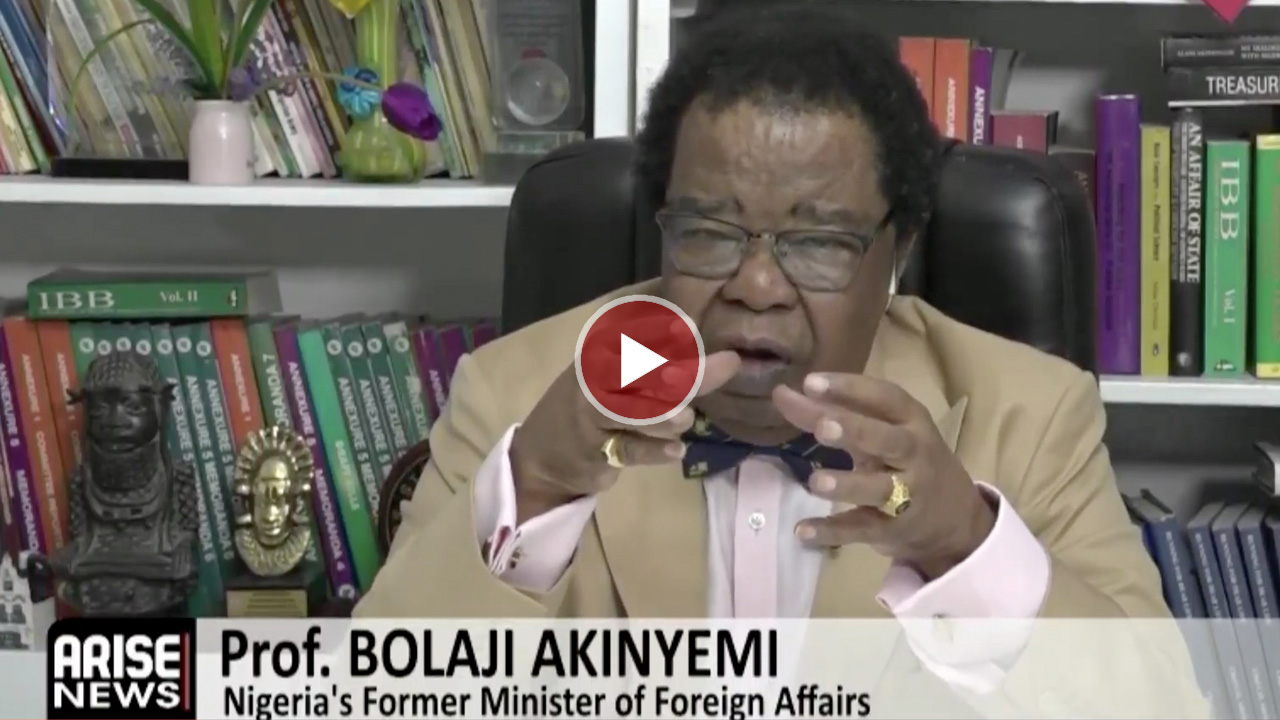
Professor Bolaji Akinyemi, who once served as Nigeria’s Minister of Foreign Affairs, has expressed concern regarding the current dynamics of opposition politics in the country, describing it as a manifestation of 'democracy of negativity' where political parties oppose governmental initiatives indiscriminately.
In an interview with Arise News conducted on Wednesday, Akinyemi noted that the contemporary political environment is more characterized by partisan rivalry rather than a cohesive national vision, pointing specifically to former Kaduna State governor Nasir El-Rufai as a prime example of the adversarial rhetoric shaping current opposition narratives.
"These days, you engage in conflict with the government in power. The rationale behind the opposition's antagonism towards the current administration is often unclear," he stated.
Akinyemi further explained that the fabric of Nigeria’s democratic culture is now increasingly reliant on instinctive opposition as opposed to constructive dialogue and collaboration.
"The democracy we are experiencing today is defined by negativity; opposition for the sake of being oppositional has become the norm," Akinyemi remarked.
Additionally, he voiced his discontent regarding the perceived lack of seriousness in governance and the management of national security issues.
"If someone claims to have intercepted the phone conversations of a National Security Adviser and is granted administrative bail by the relevant agency, then we have a serious problem on our hands. In the U.S., such a person would be incarcerated even before the court proceedings begin. Here, it seems the person is released almost immediately under administrative bail. This does not reflect a serious nation," he stated.
Akinyemi added, "Those managing the various agencies appear to be devoid of any effective plans to tackle these issues."
Recalling his experience in public service during the military regime, Akinyemi emphasized that he was not advocating a return to that era but wanted to highlight the difference in focus and unity that characterized those times.
"Such occurrences would not have taken place under military rule. Do not misconstrue my words; I am not calling for a military government. However, during that period, we had specific objectives," he said.
He noted that the security challenges Nigeria faces today, including terrorism and rampant kidnapping, were not present during his tenure.
"Today, Nigeria is grappling with Boko Haram, ISWAP, and a surge in kidnapping incidents. These issues were nonexistent during my time in office," he explained.
Akinyemi contended that the lack of a long-term, unified vision has hindered national progress since the transition to civilian rule.
"The only administration that I can recall since June 12 that had a consistent vision was the government of Olusegun Obasanjo in 1999," he asserted.
He cautioned that while the two-term constitutional limit may appear democratic, it leads to negative outcomes when succeeding administrations dismantle their predecessors' initiatives.
"Often, we are unaware of what we truly wish for. With a two-term limit, a new government may abruptly reverse the policies enacted by the previous one, resulting in unintended consequences," Akinyemi noted.
He raised doubts about whether the Western-style democracy in practice is truly effective for Nigeria, suggesting that it might be time to reevaluate the nation's political underpinnings.
"If individuals like me were to propose a way forward, the perspective might be met with resistance because we are operating under a complex constitution," he added.
"Countries like China, which have made significant progress, do not adhere to Western model democracies. Moreover, with individuals like Trump emerging from this system in the U.S., I am hesitant to endorse Western democracy as a solution to our challenges in Nigeria," he remarked.
Akinyemi called for a return to foundational discussions concerning Nigeria’s political framework.
"We must revisit the essentials. We attempted this during the National Conference, where I served as deputy chairman; however, our objectives were limited," he said.
Though the interview began with reflections on civil rights icon Reverend Jesse Jackson and his enduring interest in Nigeria's role on the global stage, Akinyemi's sharpest critiques focused on today's political climate, particularly on what he views as a contentious opposition environment that prioritizes rivalry over national progress.
"We need to ensure that we develop a clear vision for our nation," he concluded.
Comments (0)
You must be logged in to comment.
Be the first to comment on this article!