
Australia and the European Union have successfully finalized a landmark trade agreement designed to lower tariffs, enhance supply chains, and diminish reliance on China when it comes to critical minerals.
This deal, concluded after eight years of discussions on Tuesday, will see tariffs eliminated on more than 99% of European products entering Australia as well as on near all Australian critical mineral exports to Europe. Officials anticipate that this agreement could significantly enhance trade volumes and foster economic collaboration between the two regions.
This pact emerges amidst a backdrop of increasing global trade tensions, notably the higher tariffs implemented by the United States during the Trump administration, along with growing unease in Western nations regarding China's influence in rare earth elements and critical mineral supply chains.
Ursula von der Leyen, the President of the European Commission, highlighted the strategic partnership of the involved parties, stating, 'The EU and Australia may be far apart geographically, but our perspectives on global issues align closely.'
She further remarked, 'With new partnerships in defence, security, and trade, we are binding ourselves more closely.'
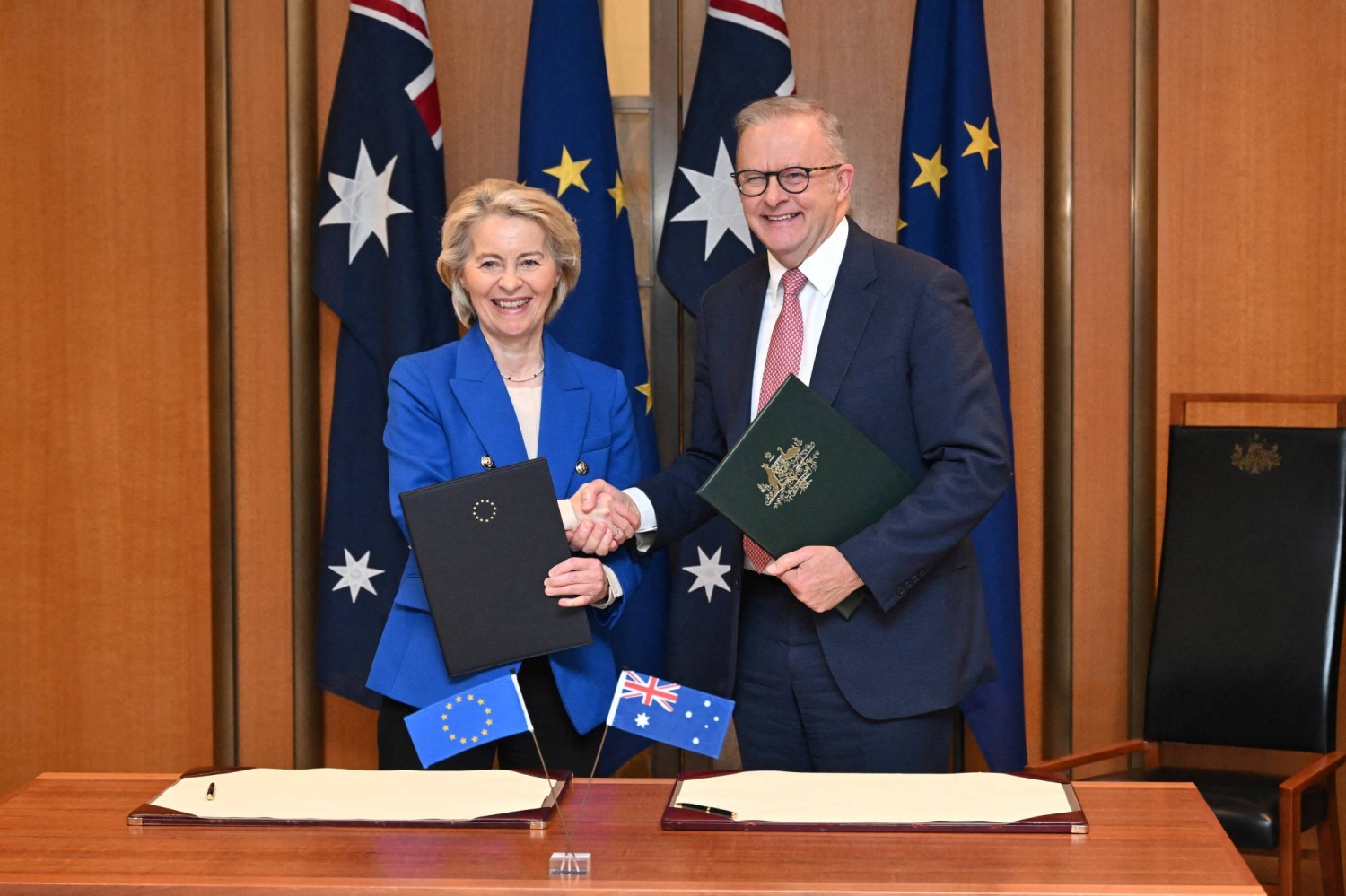
The agreement is projected to save European businesses around 1 billion euros annually in duties, with EU exports to Australia anticipated to rise by as much as 33% in the next decade.
Australian Prime Minister Anthony Albanese mentioned that the deal would provide an economic boost of approximately A$10 billion yearly, emphasizing its significance in stabilizing global supply chains through better access to essential minerals.
'For both Europe and Australia, correctly managing our relationship with China is crucially strategic, and the development of our critical minerals partnership is vital for our success,' von der Leyen articulated in the Australian parliament.
'We must avoid over-dependence on any supplier for such essential resources, and that is where our mutual support becomes critical.'
In addition to trade elements, both parties also agreed to enhance security and defence collaboration, indicative of Europe's growing involvement in the Indo-Pacific region.
However, the agreement has sparked discontent among Australian farmers, particularly concerning limited access to European agricultural markets. Traditional exports like beef and sheep meat are subject to quotas, a persistent obstacle in the negotiations.
Hamish McIntyre, President of the National Farmers Federation in Australia, expressed disappointment in a statement, noting, 'Australian farmers are extremely disappointed that negotiations for a free trade agreement with the EU have concluded without significant agricultural market access gains following Australia's exit from past negotiations.'
Under the new deal, Australian tariffs on European imports such as wine, sparkling wine, fruits, vegetables, and chocolates will be immediately reduced to zero, whereas tariffs on cheese will be phased out over a span of three years.
Conversely, the EU will grant limited tariff-free access for certain agricultural items, including a beef quota of 30,600 metric tons, with roughly 55% permitted entry free of duties.
The agreement also stipulates the protection of geographical indications for European products like Pecorino Romano and Ouzo, while permitting some continued use of names such as feta, under strict labeling rules regarding origin.
To benefit European manufacturers, Australia will adjust the luxury car tax threshold for EU electric vehicles to A$120,000, thereby exempting around 75% of these vehicles from tax obligations.
Trade relations between Australia and the EU remain significant, with European firms exporting goods worth 37 billion euros to Australia in 2025 and services amounting to 28 billion euros in 2023. The EU stands as Australia’s third- largest trade partner and the second-largest source of foreign investment.
Comments (0)
You must be logged in to comment.
Be the first to comment on this article!