
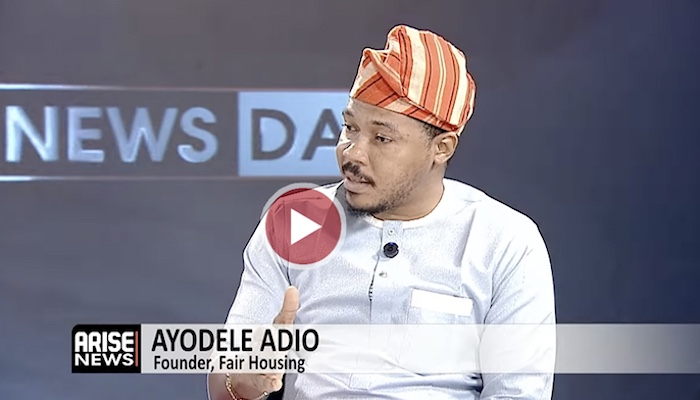
Ayodele Adio, the founder of Fair Housing, has expressed concern that the Lagos State government's lack of action has led to soaring rental prices, pushing working and middle-class individuals out of the housing market.
In an interview with ARISE News, Adio emphasized that the government's response to the ongoing housing crisis fails to address the urgency faced by residents throughout the state.
"To be fair, there has been no response at all, let me be quite honest with you, and I find this a fundamental betrayal of this generation, particularly my generation," he stated.
He pointed out that the paradigm of housing in Lagos has shifted from being considered a public good to a tradable asset, a transformation he attributes to the priorities set by successive state administrations.
"There has been a fundamental shift from how the current administration, which has been in power for 24 years, perceives housing, moving it from a public good to a commodity that is solely tradeable," Adio noted.
He stressed that the issue now extends beyond low-income earners, with working and middle-income families increasingly unable to cope with rising rents.
“The reality is that working and middle-income individuals are facing significant challenges due to rent increases, making it nearly impossible for people of my generation to attain home ownership in Lagos State,” Adio remarked.
He criticized the focus on public-private partnerships, which he claims predominantly benefit luxury housing projects, leaving a large portion of the population unserved.
Adio described the situation as a betrayal by a political class that once benefitted from social housing and public amenities.
“That, I repeat, is a fundamental betrayal of this political class that enjoyed social housing and all the public services that were available in the 1970s and perhaps even the 1960s,” he stated.
He cautioned that prolonged exclusion from home ownership could lead to deep- rooted frustration among the youth.
“We are potentially leading to a situation similar to the past, amidst a backdrop of hopelessness for young individuals who see their entire earnings directed toward basic needs like food, electricity, and housing, leaving them unable to pursue anything else,” Adio warned.
He added that limited access to land and property stands as a significant barrier to achieving economic stability.
"Property, land and property, acts as the cornerstone for wealth creation and prosperity. Excluding individuals from this process removes the means through which they can elevate their circumstances," he articulated.
Adio drew attention to the disparity between struggling residential markets and the ongoing expansion of luxury developments in both Lagos and Abuja, indicating that the luxury housing sector is part of a global speculative market.
“Luxury housing exists within a global context, meaning it’s not exclusively marketed to local populations within an economy,” he explained.
He pointed out that many upscale properties remain unoccupied.
“When you drive past these developments, many of them appear empty because they are speculative investments,” he noted.
According to Adio, cities that focus on affordable housing impose higher taxes on vacant luxury properties and mandate that developers include affordable units in their projects.
“Once developers are granted the rights to erect luxury homes or estates, they must also allocate a substantial number of units for working-class individuals within those developments,” he asserted.
He highlighted the financial burdens faced by salaried workers, underscoring the disconnect between income levels and housing costs.
“Imagine, as a young person, earning 500,000 Naira in Lagos is considered a decent salary. However, the average cost of a two-bedroom apartment in the city is around 4 million Naira,” Adio stated.
This economic imbalance leaves little room for essential living or long-term planning.
“One cannot even afford to get married or provide an education for their children,” he lamented.
Adio outlined Fair Housing’s ongoing efforts, advocating for rent control measures and sustained investment in social housing initiatives.
“I am pushing for a range of regulations aimed at capping home prices for a significant duration and ensuring ample investments in social housing,” he remarked.
He further suggested that rent increases should correlate with inflation rates.
“Rent costs need to be linked to inflationary income; rents should not outpace the growth of inflationary income in any scenario,” he emphasized.
Adio also called for stricter regulations concerning short-term rentals and commercial enterprises operating within residential zones.
“We need to impose higher taxes on Airbnb rentals in residential sectors and restrict the extent of commercial activities occurring in those areas,” he declared.
He concluded by stating that addressing this crisis demands political will and a commitment to policy-driven solutions.
“It requires political solutions. Many of the reforms we advocate for must be championed by the political class. I regard the working class very seriously,” he stated.
Comments (0)
You must be logged in to comment.
Be the first to comment on this article!