
Professor Bongo Adi, an Economics Professor at the Lagos Business School (LBS), has stated that Nigeria's macroeconomic indicators are showing improvement. He highlighted the stabilisation of the exchange rate and a decrease in inflation, suggesting that recent economic reforms are bolstering the country's overall economic standing. However, he also acknowledged ongoing concerns regarding the impact of these conditions on citizens facing elevated living expenses.
In an interview with ARISE NEWS, Professor Adi discussed Nigeria's fiscal policy for 2026. He commented on the current economic landscape, stating, "I think it speaks to the micro more than the macro. I think we’ve had a lot on the macro side because if you look at and analyze the system as it is today, you will notice that everything seems to be very strong on the macro side. We have all the indicators pointing upwards; the scenery has boosted significantly and very strongly. We also have the exchange rate that has somehow steadied for quite a long time now, and then the parallel market and official rate gap has narrowed significantly."
He further elaborated on the positive macroeconomic trends, noting, "On the macro side, I think things have been looking up. Of course, inflation has been dropping, even though that is now being challenged by what is going on in the Gulf region."
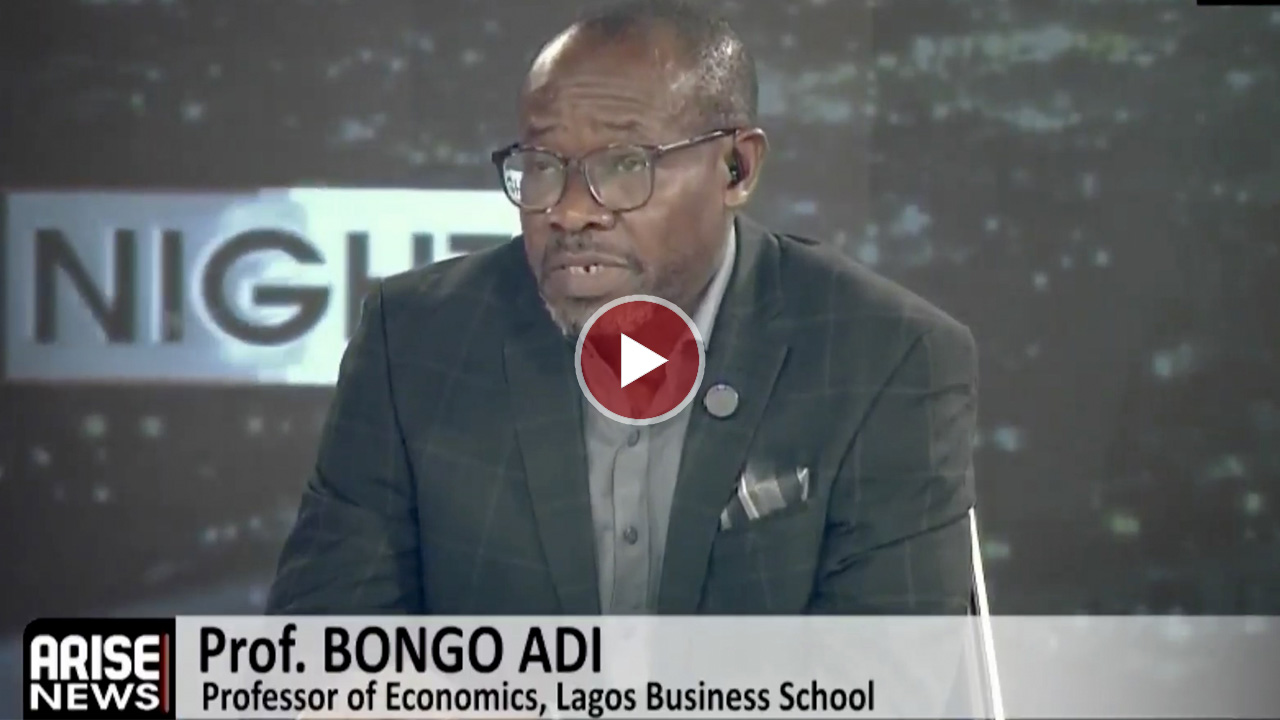
Professor Adi also addressed the potential disconnect between tariff reductions and immediate price relief for consumers, attributing this to current economic conditions that limit purchasing power. He observed, "This is not a time many Nigerians are buying cars because the income—if you look at per capita income—it has shrunk significantly. And, of course, we haven’t seen the data on unemployment in recent times, but if you go by anecdotal evidence, you will know that unemployment is on the high side. So, that’s not an economy where people will be buying a lot of vehicles."
He explained that while policies like tariff reductions on imported goods such as vehicles, rice, and sugar are designed to enhance welfare through supply- side interventions, more immediate relief could be achieved through demand- side measures that boost household income and spending capacity. "What I see here, we’re looking at it as a kind of supply-side policy to really increase the welfare of citizens. But I think what would be of more impact would be from the demand side. And what would that demand side be? Having a policy that puts more money in the pocket of people. One of them would be the removal of subsidy one way or the other. I mean, the return of the subsidy, whatever name they call it; that would really serve to increase living standards and improve the welfare of citizens in the shortest period of time," he suggested.
Professor Adi pointed out that Nigeria's high levels of inequality mean that the benefits of such policies may not effectively reach the general populace. He stated, "Now, another thing that happens with an economy where inequality is very high, as it is in Nigeria today—we have inequality, if you measure it by the Gini coefficient, it’s around 50%. Inequality goes from 0 to 1 in the measurement; 0 means that it’s equal distribution, everybody has the same proportion of income or resources. When it is 1, it means that just one individual dominates everything. 50 means that 50% of the population control everything and then the rest of the 50 have just nothing, to put it in layman’s terms. That tells you that a lot of people really have nothing. And then the poverty rate, everybody knows what it is: many Nigerians, 65% or so of the citizens, live below $2 a day. That’s huge," he noted.
He suggested that reducing the cost of living would ensure government interventions have a more direct and positive impact on the welfare of ordinary Nigerians. "What I think would be to the benefit of the people is if we go in the direction of some demand-side, increase aggregate demand by reducing the cost of living. What could do that better than some reimbursement of subsidy, one way or the other, to reduce the cost of energy? That will directly impact transportation. When you talk about the inputs to production and the inputs to living standards, transportation is one and energy is the other. If we can reduce that—the cost of transportation and the cost of energy—then you will now be sure that government policy or government actions are having a positive impact on the welfare of citizens."
Discussing the effect of tariff reductions on agriculture, Professor Adi stated that Nigeria's previous protectionist policies yielded mixed results, with limited success in rice and wheat production. He explained that while these measures aimed to support local farmers, productivity growth was hampered by the necessity of importing essential inputs. "There is no policy that doesn’t have winners and losers, however you look at it. So, the way I would look at that is, you know, we go back some few years ago. There were these protectionist policies whereby government slammed tariffs on the import of those commodities under the infant industry protection measures. Import substitution—that’s what the Buhari administration under the Central Bank actually worked very hard on."
He added, "And that had an effect. When the evaluation assessment was done at the end of that tenure, we found out that only on rice and wheat did we register some significant improvement in the sense that volumes of production increased with the policy regime. But in other areas, it didn’t quite work. Why? Because in order to produce in Nigeria, you need to also import equipment; you need to import so many inputs. So without those inputs, you can’t have those productivity gains," he explained.
Professor Adi concluded that while opening up trade might increase competition for local farmers, it could also enhance productivity by ensuring access to crucial equipment and inputs required for large-scale agricultural operations. "The argument here is that if you liberalize your trade and allow everything to come in, it will damage your capacity to grow—the capacity for the local industry to grow the necessary capability they need to compete in the global world. Especially today where we have this recession of globalization or globalism. You’ve seen it in the United States and other countries that are escalating tariffs, but here we’re going the other way around. I think our situation is quite different. In order to boost productivity, of course, we need to have those inputs to keep production going."
(By Favour Odima)
Comments (0)
You must be logged in to comment.
Be the first to comment on this article!