
China has officially imposed a ban on concealed door handles for electric vehicles (EVs), prioritizing safety amid rising concerns. This decision particularly targets designs popularized by Tesla and others, following several serious incidents, including fatal accidents involving Xiaomi EVs, which highlighted issues with accessing door handles during power outages.
Effective from January 1, 2027, the new regulations mandate that all vehicles must be equipped with mechanical door releases accessible from both the inside and outside. The Ministry of Industry and Information Technology has established that each passenger door (excluding the boot) must feature a recessed area measuring at least 6cm by 2cm by 2.5cm to facilitate handle access. Additionally, there must be clear indicators inside the vehicle, measuring at least 1cm by 0.7cm, to show how to open the doors.
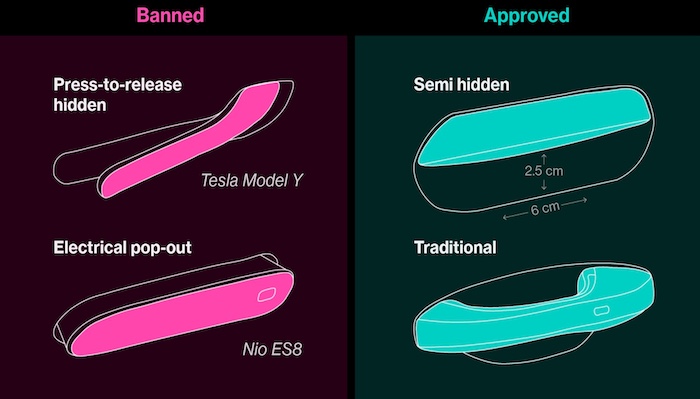
Vehicles that have already received approval for sale will be given a two-year period to adapt their designs to comply with the new standards. Currently, hidden door handles are prevalent in China’s new energy vehicle (NEV) sector, appearing on around 60% of the top 100 best-selling electric, hybrid, and fuel cell vehicles.
Although the ban is restricted to China, its repercussions are expected to resonate globally owing to the significant influence China wields in the automotive market. Tesla, in particular, is under increased observation; the US National Highway Traffic Safety Administration (NHTSA) is looking into issues with the door handles of its Model Y, following reports of sudden failures that left occupants, including children, trapped inside the vehicle. Some owners were even forced to break windows to escape. Meanwhile, European regulators are also contemplating similar actions.
Erizia Rubyjeana
Follow us on:
Comments (0)
You must be logged in to comment.
Be the first to comment on this article!