
Aliko Dangote, the President of Dangote Group, has outlined his company's strategy to enter the steel, power, and port sectors, aligning with a broader ambition to enhance industrial growth across Africa.
This initiative coincides with the recent onboarding of 330 graduate engineers at the Dangote Petroleum Refinery and Petrochemicals, underscoring the company's dedication to developing local talent and reinforcing Nigeria's engineering workforce.
Dangote, whose business empire includes cement, sugar, salt, fertilizers, and petrochemicals, aims to strengthen Africa's manufacturing capabilities beyond oil refining and position the continent as a leading industrial player globally.
The flagship Dangote Petroleum Refinery & Petrochemicals has been operational for over two years, processing various petroleum products with a production capacity of 650,000 barrels per day. The billionaire entrepreneur anticipates that the refinery's output will double over the next three years as part of its expansion plans.
In a recent conversation with The New York Times, Dangote expressed that refining is merely one aspect of his larger vision. "We need to industrialize Africa," he stated, specifying that his subsequent focuses will include the steel sector, improving electricity access, and enhancing port infrastructure to facilitate large-scale manufacturing and trade.
According to market analysts, the company's entry into the steel industry will strategically position it within a sector essential for infrastructure, housing, and heavy industry, while investments in power and ports address critical barriers to Nigeria's economic growth.
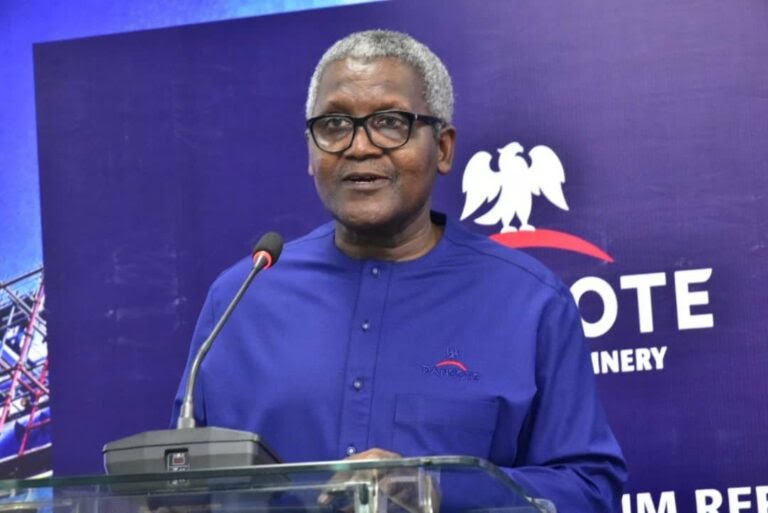
Dangote cited the Tata Group from India as an exemplary model of diversified industrial growth, indicating that extensive manufacturing has the potential to transform emerging economies.
Job creation remains a cornerstone of Dangote's strategy. With Nigeria anticipated to need between 40 and 50 million new jobs by 2030, he argues that large-scale industrial ventures are vital for accommodating the nation’s growing youth demographic.
Currently, the refinery employs around 30,000 individuals, with about 80% being Nigerian nationals. The expansion into additional sectors is projected to increase total employment within the group to approximately 65,000, as disclosed in the statement.
Furthermore, Dangote is planning to list shares of the refinery on the Nigerian stock exchange, which would enhance local participation in the venture. Despite achieving these milestones, he acknowledged ongoing hurdles such as infrastructure deficiencies and crude supply challenges.
He previously voiced concerns regarding logistical issues and inefficiencies in the oil supply chain that complicate sourcing feedstock for the refinery.
Nonetheless, Dangote affirmed that the group would persist in making substantial investments in sectors that minimize import reliance and retain economic value within Africa.
"No one else dared to undertake this, but we did," he reiterated, emphasizing his viewpoint that large-scale private investments are crucial for transforming Nigeria’s industrial landscape.
With cement production facilities operating throughout various African nations and a refinery altering Nigeria's downstream prospects, Dangote’s foray into steel, electricity, and port infrastructure marks a new chapter in his vision to industrialize the continent.
Moreover, the Dangote Petroleum Refinery and Petrochemicals has successfully inducted 330 new graduate engineers into its technical workforce, further demonstrating its commitment to enhance local content development and elevate Nigeria’s engineering talent.
The induction ceremony, held at the refinery site, officially welcomed the new engineers selected from top universities throughout the nation. They join a group of trainees who have received world-class training, technical mentorship, and rotational exposure across the key units of the refinery and petrochemicals sector.
During his address, the Chief Executive Officer of the refinery, Mr. David Bird, characterized this development as a strategic milestone in the company’s investment in human capital. "This induction represents another vital step in our objective to build local capacity, strengthen Nigeria’s engineering base, and ensure consistent operational excellence across our integrated energy framework," Bird stated.
He commended the new recruits for their exceptional performance throughout the program, encouraging them to continue learning and growing. "The training has adequately equipped you for what is expected of you in a world-class, modern refinery like the Dangote Petroleum Refinery and Petrochemicals. We anticipate excellence, innovation, and dedication in your respective areas of operation," he urged.
The newly inducted engineers, specializing in disciplines such as Chemical Engineering, Electrical and Electronic Engineering, Mechanical Engineering, and Instrumentation, culminated their training with project presentations and defense before management.
Their projects encompassed modeling the complete refinery operations, conducting research and development, and proposing viable solutions to ongoing and future operational challenges.
Dr. Ebele Oputa, the Coordinator of the program and Assistant General Manager of Human Asset Management, emphasized that the initiative highlights the refinery’s commitment to fostering local talent. "The refinery management designed the training program to ensure that young engineers could connect the theoretical knowledge acquired in their studies with practical training offered at the refinery," she explained.
She noted, "This approach is aimed at enhancing their practical and leadership skills over time, allowing them to effectively guide their teams in their professional and personal growth. While some may have a natural inclination to lead, leadership skills can also be developed, enabling all management trainees to excel in leadership roles over time."
Furthermore, she indicated that the structured training pathway would elevate the engineers’ confidence and prepare them for workplace challenges, detailing, "They undergo induction, shadowing, equipment classes, hands-on training at the refinery, unit-specific training in the production area, and supervised work with coaching throughout the remainder of their training period."
Comments (0)
You must be logged in to comment.
Be the first to comment on this article!