
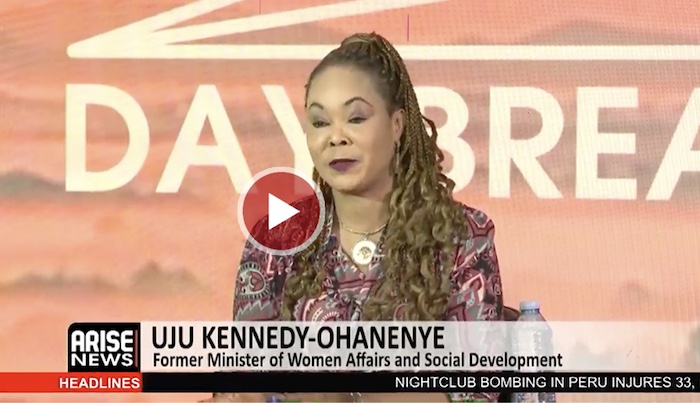
Former Minister of Women Affairs, Uju Kennedy-Ohanenye, has asserted that women need to actively contend for their rights to be included in national discourse and decision-making, rather than simply anticipating an invitation.
She conveyed this sentiment during a recent interview with ARISE NEWS on Monday.
"We have been pursuing it. Women have been… we are getting more serious than ever. You know, before now, women were just waiting—how is it going to be? Are they going to call on us? I don’t believe in folding our hands and waiting to be called upon. I believe in working hard to fight for those our rights," she stated.
She further advocated for increased opportunities for women in both economic development and political participation.
"They’ve given us the 35%. But can we get it without jobs? Can we get it without appointments? We need more appointments. I know the President, Bola Ahmed Tinubu, is trying; his administration is doing well concerning women. But we need more. We’ve not really gotten to the 35% up to date. And if you watch any job given to a woman, you see a huge difference. We are more committed. We have this motherly thing in us—that we want to look out and take care of our own. And Nigeria is like a child to us.
"So, we are truly working. But we can’t get that without having a job, having money. When you can see only 10% of women have properties, you see we are poor. We really need to work on this. Let them give us more opportunity to have a job and then to equally get more exposed in politics," she said.
Barrister Kennedy-Ohanenye pointed out that while government reshuffles affect both genders, they draw more attention when women are involved due to their underrepresentation in leadership positions.
"I don’t think I look at it as a gender issue. I could be removed, and Doris could be reshuffled and be taken to the different ministries. It equally happens to men—just that we are few, so when it happens to a woman, it makes a bigger news than when it happens to men. So, I don’t look at it as a gender issue. And at the same time, we’re not equally folding our hands. Even if you’re removed, you don’t give up," she stated.
Addressing the perception of her tenure being marred by controversies, Kennedy-Ohanenye countered that her firm approach stemmed from a commitment to accountability and safeguarding women and children, asserting her conviction in those past actions.
"I can’t regret it because I tried the other approach initially—and probably the other Ministers before me have been trying that same approach—and it did not work. I had to confront it. To tell you the truth, I am not regretting it. We must have to be reasonable. We don’t sit down and keep blaming; it’s not government, it’s us," she said.
Regarding an incident involving Senator Natasha last year at the National Assembly, the former minister characterized it as an "internal matter" rather than a reflection of broader issues concerning women's inclusion.
"I don’t think so it is a reflection of the way women are placed in society. Because Senator Natasha’s case, as you can see, was somehow an internal thing and it has been handled the way it was handled," she stated.
She expressed full support for the push for special seats for women in the National Assembly, but concurrently stressed the ongoing importance of women's economic empowerment.
"I support it fully. But when you give the special seats and only 10% of women are rich, who are the ones to occupy the special seats? That’s another problem. That’s why I keep saying we need to get jobs, we need to come out there and believe in ourselves—that we could equally do it, we could equally work hard. So even after giving us seats—of which we are praying and following and fighting for—we still need to work harder," she said.
She refuted the notion that female lawmakers exploit their gender as a tactic, deeming such claims baseless.
"I don’t think so. How can they even play the gender card? In the Senate, I believe they usually have a particular thing they address and the laws they follow to either approve or disapprove, to say ‘yea’ or ‘nay.’ How can they play the gender card in such a situation? I don’t think so," she insisted.
Discussing the reported sexual harassment case at the University of Calabar, Barrister Kennedy-Ohanenye clarified that her intervention was aimed at protecting the victims, uncovering the truth, and ensuring justice, not at intimidating or undermining anyone.
"When I had that issue, I personally called these girls. I got their number from their VC and I called them to give them assurance that as far as this matter is concerned, I was going to fight for them. There’s no way I can support such a thing. That was an opportunity for me to fight these men and bring them down.
"But unfortunately, the same girl started crying to me that nothing was done to her. I have evidence of this. She told me nothing was done to her; she’s being pressured by the VC and co to say these things. I’m telling you, I had to record it for a reason—to be on a safe side.
"Then after that, the next thing I heard, I heard that she was now going to talk. I called her and I said, ‘Stand by the truth. If you know the truth, stand by the truth. I want justice to be done.’ And after I spoke to her on that, I equally gathered the university students and we wrote to the DSS to carry out a thorough investigation on this. I was only looking for the truth to be out. I don’t want nobody to be maltreated—not the male and not the female. So it was based on what she and the other girl told me that made me talk to her like that," she explained.
Favour Odima
Follow us on:
Comments (0)
You must be logged in to comment.
Be the first to comment on this article!