
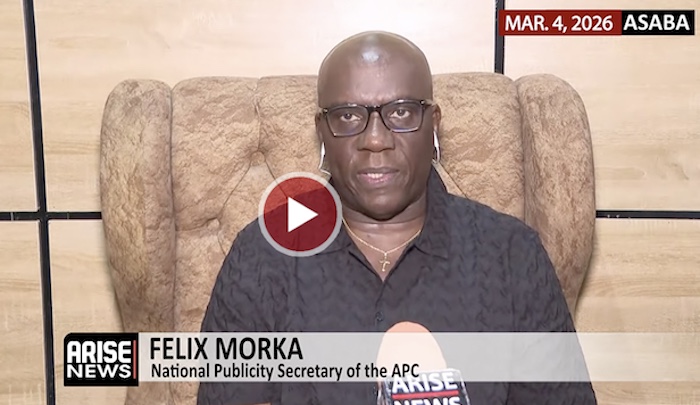
Felix Morka, the National Publicity Secretary of the All Progressives Congress (APC), has spoken in favor of the party's recent congresses, claiming they were predominantly peaceful despite some disputes and legal challenges faced in certain states.
In an interview conducted with ARISE NEWS on Wednesday, Morka refuted claims that the ruling party was presenting a misleading picture of its internal processes. He emphasized that the APC successfully executed a complex nationwide undertaking that reflected its status as one of the largest political parties not just in Nigeria but potentially in Africa as well.
“No system is flawless. We have never claimed to be perfect. We are human beings, and we make mistakes. However, what's crucial is that our party has conducted congresses that we can confidently state were largely peaceful and cohesive,” he stated.
Morka recognized that there were isolated issues. “As a political party, we respect court orders. We strive to adhere fully to judicial directives. Compliance is only feasible when the order is known to us.”
He noted that in some states, congresses were suspended due to various challenges, which are currently under review by the party's relevant authorities. He preferred not to speculate on the ongoing discussions or possible resolutions related to these matters. He clarified that situations arise where an interim court order is granted in the absence of the other party, which may complicate congress proceedings.
He reiterated that internal conflict resolution is a key strength of APC.
“I have consistently mentioned, even during your show, that a distinguishing feature of the APC is our advanced conflict resolution systems. We don't take this for granted, acknowledging that conflicts may arise. Members may express disappointment and grievances. Just because they are part of the party doesn’t mean they will always agree with every decision. They possess constitutional rights to voice their concerns, and we always welcome such input,” he added.
Morka also responded to allegations suggesting that the APC had manipulated the recently enacted Electoral Act to harm opposition parties. “We are not using coercion or intimidation, nor do we have any motive to do so against any opposition entity,” he said.
He stressed that the Electoral Act 2026 is a product of the constitutional authority of the National Assembly. “We are not the National Assembly. The Assembly comprises elected representatives from various political factions. Certainly, we hold the majority, but that does not mean that the actions of the National Assembly should be attributed to the APC. Such reasoning is unfair and illogical,” he remarked.
He rejected criticisms from opposition parties, labeling them as unfounded. “These claims from the opposition are weak and do not add up. We, the APC, are just as affected by the rules as are all other political parties. I fail to see how the APC enjoys an unfair advantage or unjustly influences the electoral processes. We are not engaged in such practices,” he stated. Morka noted that the Electoral Act has abolished the indirect primary system for conducting elections, highlighting that the APC respects the National Assembly's authority and expects others to do the same.
Regarding the fast-tracked approval of the bill, Morka explained, “We have a bicameral legislature. The National Assembly is divided into two chambers: the Senate and the House of Representatives. Bills must receive agreement from both chambers to become law. If disagreements arise, a conference between the two houses typically works to reconcile the differences.”
He stressed that only a unified version of a bill is valid for presentation to the President. “Any legislation originating from the National Assembly, which includes both the Senate and the House, must be cohesive. Thus, any bill passed by either chamber must be harmonized before it can be sent to the President,” he clarified.
On the timing of presidential assent, Morka insisted that there was no violation of constitutional protocols. “There’s no specific timeframe mandated by the Constitution for the President to wait before signing a bill. He has the discretion to assent immediately or delay or reject the bill altogether,” he explained.
He concluded, “The president has signed it, and presently we have the Electoral Act 2026 in force, which is the legal framework currently in place.”
Morka highlighted a recent directive from the Vice President during a summit with governors from the Progressive Governors Forum, where he called for unity and resolution of differences among leaders in Benue. He described this call to action as indicative of the party leadership’s attentiveness to internal conflicts. “This shows that our leadership is committed to addressing the situation in Benue. It is imperative for the party’s unity and the people's welfare that they find common ground,” he stated.
He emphasized that finding resolutions is essential for the party's future, especially leading up to the 2027 elections, urging unity for the benefit of both the APC and the constituents of Benue.
Comments (0)
You must be logged in to comment.
Be the first to comment on this article!