
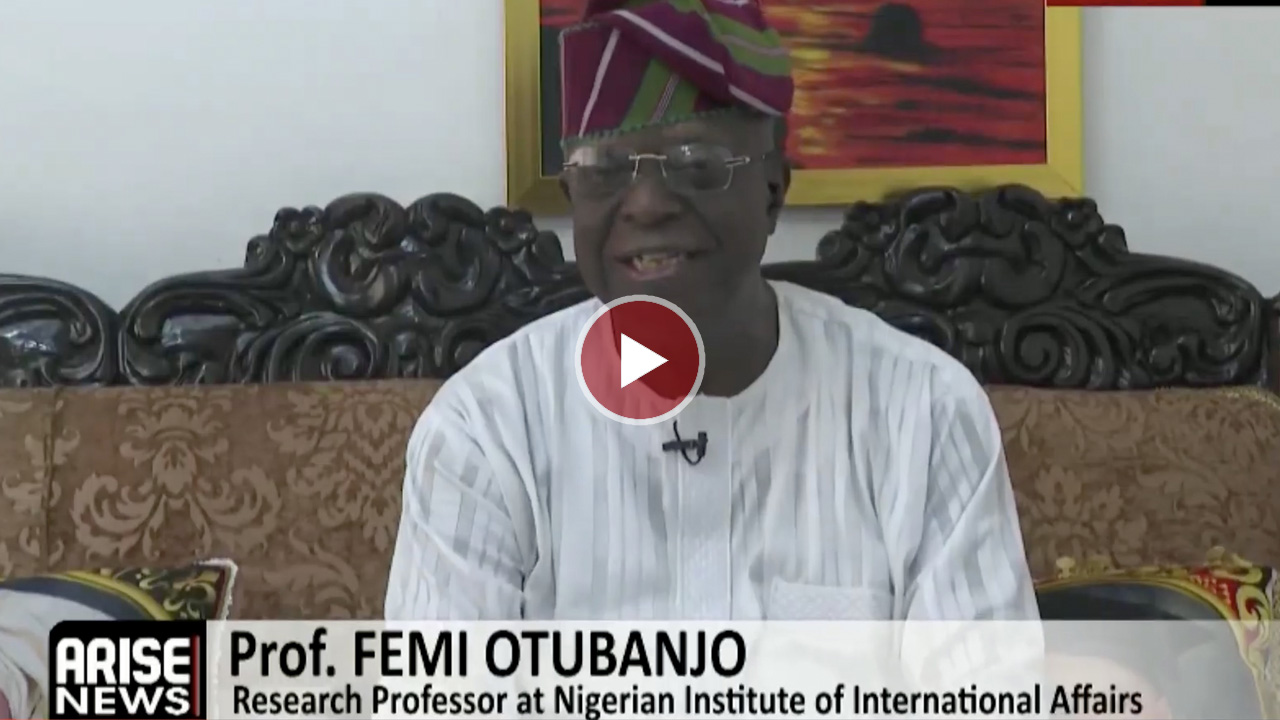
Femi Otubanjo, a prominent Research Professor at the Nigerian Institute of International Affairs, has declared that the conflict currently unfolding in the Middle East is both unnecessary and unprovoked, primarily fueled by geopolitical aspirations and political calculations rather than any real security threat.
In a conversation with ARISE NEWS on Tuesday, Otubanjo expressed strong criticism regarding the involvement of the United States and Israel in the situation, claiming that the US was close to finalizing a nuclear agreement with Iran before abruptly opting for military action.
"This war is needless and unprovoked," he stated. "At the moment the US announced this war, an agreement was on the brink of being finalized. There was an understanding in place that had been facilitated by Oman, set to be officially signed just two days later."
He pointed out Iran's previous commitment to cease uranium enrichment, stating, "Iran had clearly said it would not enrich uranium or pursue nuclear weapons, and that it was open to international inspections. Reports indicate that the agreement was ready for signing. They had reached terms; however, Trump believed it fell short due to pre-existing motives to engage in war."
Otubanjo highlighted the long-term strategic implications of the conflict, asserting, "Israel stands to gain significantly if it succeeds in overpowering Iran. Should Iran be subdued or undergo a regime change that aligns with Western interests, Israel's longstanding agenda of dismantling, destabilizing, and destroying its adversaries would have achieved another milestone."
He further referenced past US military actions, highlighting a continuous pattern. "The objective has been to weaken those nations to prevent them from opposing Israel’s interests. Countries like Iraq, Syria, Lebanon, Sudan, Yemen, and Libya have all ended up destabilized. Iran was the last stronghold, and that is the target now."
In addition, he pointed out that beyond the immediate conflict, the military- industrial complex of the United States gains significantly from such wars. "Stocks of defense contractors have risen. The military-industrial complex in the US is very much reliant on continuous conflict. Trump, personally, stands to benefit from this war since he operates under delusions that America must assert itself to obtain its demands."
Referring to historical military campaigns in Iraq and Afghanistan, Otubanjo warned that an invasion of Iran would likely be prolonged. "When Americans went into Iraq, the mission extended over eight years; in Afghanistan, it took 21 years—the longest war in US history. Now consider Iran, which is a much larger nation."
He elaborated on the significant challenges posed by Iran’s size, population, and rugged landscape: "With a population of around 90 million, Iran has complex terrain including mountains and deserts, and it is home to fiercely dedicated fighters who have shown willingness to die for their cause. Such suicide attacks bring unique and severe challenges in combat."
He predicts that if the conflict begins, it will extend beyond Trump’s administration. "If it commences today, it will not conclude before he leaves office."
On the broader economic implications, Otubanjo said that disruptions in the Strait of Hormuz will have dire consequences on oil trade and insurance costs. "This will subsequently drive up oil transportation costs, requiring ships to navigate around the Cape of Good Hope, leading to higher oil prices and increased insurance fees."
While he acknowledged that oil-exporting nations might see some short-term financial benefits, he cautioned against the overall economic impact of warfare. "War does not foster a prosperous economy. It is notoriously difficult to rebuild a nation post-conflict, especially when engaging in regime changes. Therefore, my outlook is not optimistic."
His expectation for a new regime in Iran is contingent upon ground realities, remarking, "If there ever is a movement against the current regime, and if American forces can seize control of the capital, the outcome heavily relies on the situation that develops once they arrive."
Addressing Nigeria's strategic direction, Otubanjo supported earlier suggestions from Professor Bolaji Akinyemi concerning Nigeria's pursuit of nuclear capability, deeming it a missed opportunity for developmental advancement. "Ultimately, Akinyemi's stance was correct. The rationale behind acquiring such a capability was to facilitate infrastructural development. If we had pursued nuclear capacity, it would have required advancements in electricity, roads, and thereby spurred numerous developments. We let that chance slip by."
He asserts that acquiring nuclear capabilities could have served as a protective measure against aggression. "It would ensure that if we were under threat, we would not be easily attacked. If you're not at the negotiating table, you're on the menu."
Comments (0)
You must be logged in to comment.
Be the first to comment on this article!