
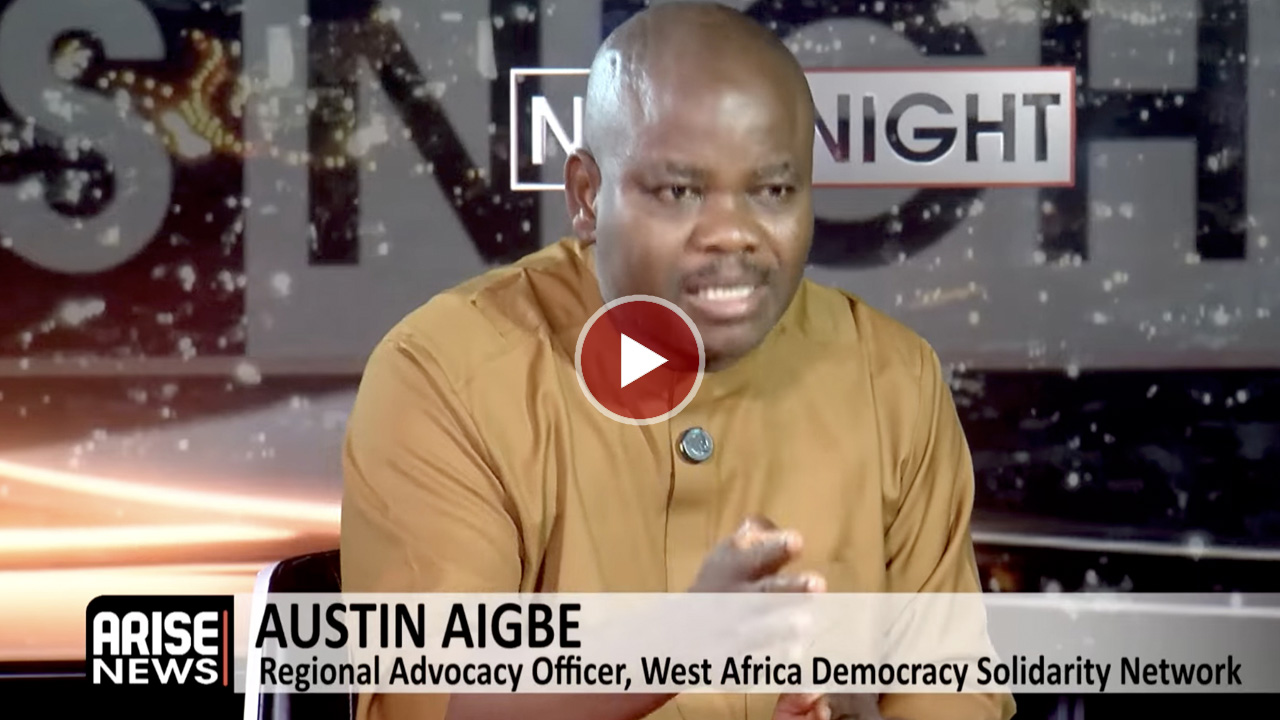
Austin Aigbe, who serves as the Regional Advocacy Officer for the West Africa Democracy Solidarity Network, has indicated that the suspension of voter revalidation by the Independent National Electoral Commission (INEC) is largely a public declaration, while the commission continues its internal preparations.
Speaking with ARISE NEWS on Monday, Aigbe discussed voter revalidation and the state of electoral integrity in Nigeria.
"I concur that it has been suspended, but what is suspended is the public communication and formal rollout. Nevertheless, internal planning is still underway, so we cannot be certain if it will be revisited after their next meeting," he commented.
Aigbe underscored the critical issue of low voter turnout in Nigeria, noting that despite a registered voter base exceeding 93 million, actual participation typically hovers between 28% and 30%. He highlighted that this disparity leads to substantial waste, with millions of ballot papers printed but left unused, resulting in considerable expenditure.
"I agree with the INEC Chairman's remarks concerning the timing. In the 2024 Ghana election, we frequently reference the high turnout, questioning why Nigeria cannot achieve similar levels. Nigeria's voter participation generally falls between 28% and 30%, which is arguably low.
"We allocate significant funds to prepare for 93 million registered voters, yet the actual turnout is substantially lower. I have conducted a metaphorical analysis: if 100 million ballot papers are printed and turnout is only 30 million, that means 70 million are wasted. We spend money to print them and more money to dispose of the unused ones, all while the nation is in debt.
"There are methods to mitigate this waste. I believe this is the opportune moment to discuss electronic voting systems – not internet voting, but rather electronic voting similar to what Kaduna State employed for its local government elections in 2018. Voters would still cast their ballots at polling units. Revalidation is necessary to remove deceased individuals and those who have emigrated. A legislative framework should be established where the voter register is reviewed every decade," he proposed.
Aigbe further elaborated that incomplete revalidation processes contribute to an inflation of active voter numbers.
"It's a fact. There might only be 50 to 70 million genuine registered voters because many have not revalidated. Nigerian law mandates a permanent register, necessitating amendments to that law. Would it be feasible to conduct voter registration well in advance of each election? The Nigerian system faces challenges, but the core issue is that such policies should not be implemented merely 18 months before an election, as it sends an unfavorable message. With a four-year interval between elections, why is this being addressed now?"
Aigbe argued that accelerating revalidation at this juncture conveys an inappropriate signal, as trust remains the fundamental obstacle.
"I directly questioned the INEC Chairman: 'Can we place our trust in you?' He acknowledged that trust is a significant concern. Such programs should not be initiated solely due to budget allocations. INEC operates under a very demanding timetable. Even the one-year notice period is barely adequate. Revalidation effectively functions as a new registration, and individuals are already expressing difficulties with online registration or scheduling physical data capture.
"Instead of expending resources on revalidation now, why not focus on refining the existing register and planning for a comprehensive registration cycle beginning in 2028? Voter registration should be integrated with electronic voting for better synchronization. If India, despite its literacy challenges, can utilize devices for voting, why can't Nigeria? People point to a lack of internet connectivity in rural areas, yet internet access exists for making calls and sending messages from those same villages. It is logical," Aigbe stated.
Explaining further, Aigbe clarified that the cleaning process primarily addresses duplicate registrations and does not facilitate the removal of deceased voters, which requires verification from the National Population Commission.
"The cleaning process he referred to only identifies duplicate registrations. It does not remove deceased individuals. To remove a deceased person from the register, verification from the National Population Commission is required. We have even witnessed instances where politicians have printed fraudulent obituary posters of opponents in an attempt to have them removed from the voter roll!
"To accurately determine who is alive or deceased, proof is essential – including hospital certifications and legal documentation. It is a complex procedure. The Chairman is aware that merely stating someone has passed away is insufficient; proper justification and evidence must be presented," he concluded.
Comments (0)
You must be logged in to comment.
Be the first to comment on this article!