
The United Kingdom's Prime Minister Boris Johnson expressed alarm over the rising tensions in the Middle East, as Iranian strikes caused oil tankers to catch fire in Iraqi waters, contradicting President Donald Trump’s declaration that he had already achieved victory in the war he started two weeks earlier.
Verified images captured by Reuters, taken from the shores of Basra, displayed ships engulfed in large, blazing flames that illuminated the night sky.
Iraqi officials reported that the vessels were struck by Iranian boats carrying explosives overnight, resulting in the death of at least one crew member.
Earlier on Thursday, three additional ships were targeted in the Gulf. Iran’s Revolutionary Guards took responsibility for one attack that involved a Thai bulk carrier, which was set ablaze after it allegedly ignored their commands.
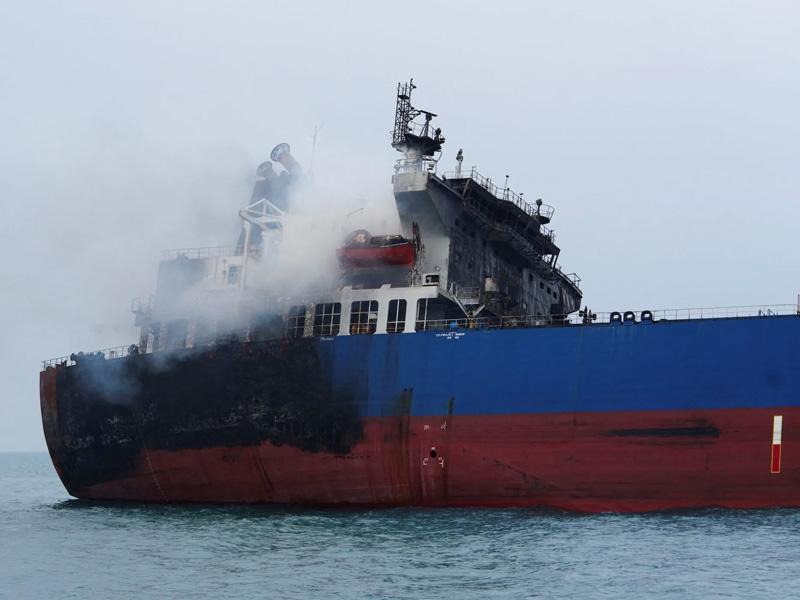
Furthermore, an unidentified projectile was reported to have hit another container ship near the United Arab Emirates, as stated by a maritime security authority.
The ongoing conflict, initiated by the United States and Israel, has, so far, resulted in around 2,000 casualties and has led to the most severe disruption of global energy supplies since the oil crises of the 1970s.
Reports indicated the flight of drones into Kuwait, Iraq, the UAE, Bahrain, and Oman on Thursday, underscoring Iran’s sustained long-range capabilities.
Oil prices, which had seen a downturn earlier in the week after Trump asserted that the conflict would swiftly come to an end, surged past $100 per barrel.
Iran has issued a warning that it will prevent oil passage through the Strait of Hormuz until US and Israeli strikes cease and has ruled out the possibility of negotiations with Washington.
Citibank recently announced temporary closures of its branches in the UAE following Iranian alerts that banks may be legitimate targets, while HSBC has shut down operations in Qatar.
The oil price escalation occurred even after a joint announcement by developed countries, which stated their plan to release 400 million barrels from strategic reserves, with nearly half coming from the United States—an intervention expected to cover merely three weeks of supply.
ING analysts noted, "The only method to observe oil prices sustain lower levels is by ensuring that oil flows through the Strait of Hormuz. If that does not happen, higher market prices are likely ahead."
During a rally in Hebron, Kentucky, Trump insisted, "We won. It was over within the first hour. We’ve nearly destroyed Iran. Nevertheless, we must not exit prematurely; finishing the task is crucial."
Despite Trump’s claims, US intelligence reported to Reuters that Iran’s leadership remains largely intact, and the nation’s military strategy now centers on establishing a prolonged economic shock to pressure Washington. Analysts cautioned that oil prices might escalate to $200 per barrel amid ongoing instability.
Comments (0)
You must be logged in to comment.
Be the first to comment on this article!