
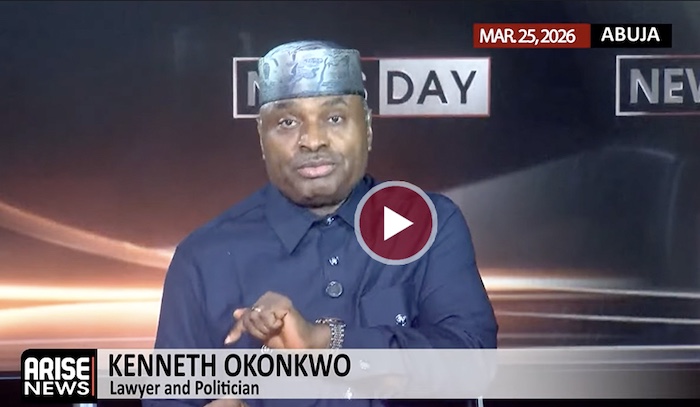
Kenneth Okonkwo, a prominent lawyer and politician, has voiced serious concerns over the state of Nigeria’s judicial system, highlighting that the root of the issue lies not in the incompetence of judges, but in their complicity, especially in critical matters such as electoral disputes.
In an interview with ARISE News on Wednesday, Okonkwo responded to comments from a former President of the Court of Appeal regarding the 2023 presidential election, asserting that some judicial interpretations have failed to align with the provisions outlined in the Electoral Act of 2022.
He clarified that the law mandates political parties to submit their membership records within a specified timeframe but does not prohibit individuals from joining a party after this deadline or from running for elections.
"Being a member of a political party qualifies you to contest in elections," he stated, emphasizing that the legal framework does not support disqualifying candidates based solely on timing.
Okonkwo also discussed the legal principle of locus standi, indicating that only individuals with a direct legal interest have the right to challenge issues in court, especially regarding internal party processes like nominations.
"A person who is not a member of a political party cannot question its nomination process," he explained.
Shifting the discussion from legal nuances to a broader concern, Okonkwo indicated that the persistent inconsistencies in court rulings suggest a deeper issue within the judiciary.
"I am much more concerned about complicity than the competence, which I believe many judges possess," he expressed.
He further elaborated that many judges are indeed capable, but decisions often seem to reflect external influences rather than strict legal interpretations, particularly in politically charged cases.
This concern regarding judicial conduct isn't new; Okonkwo pointed out that similar issues existed even when some of the current critics were judges themselves.
He called for a thorough strategy to tackle these challenges, advocating for enhanced oversight and accountability in the judiciary.
Emphasizing the necessity for transparency in the appointment of judges, Okonkwo noted that integrity should take precedence over personal or institutional affiliations.
"The appointment process must be strict… transparent, highly accountable, and devoid of conflicts of interest," he remarked.
He also stressed the importance of ongoing training for judges, especially in specialized areas such as electoral law, to keep them well-versed in the evolving legal landscape.
"Judges should undergo regular training... it should be an ongoing process to ensure they are updated," he added.
Further, Okonkwo raised alarms that without proper restrictions, unethical practices within the judiciary might continue and become normalized.
"There must be consequences... failure to deter wrongful practices will only lead to their repetition," he warned.
He urged institutions, particularly the National Judicial Council, to ramp up efforts in promoting discipline, accountability, and autonomy within the judicial Branch.
Comments (0)
You must be logged in to comment.
Be the first to comment on this article!