
At the recent World Economic Forum held in Davos, Kristalina Georgieva, who serves as the Managing Director of the International Monetary Fund (IMF), delivered a serious caution about the swift changes artificial intelligence is ushering into the global job market.
During her address to the attendees, Georgieva compared the effects of AI on employment to a massive "tsunami" that is sweeping across labor markets worldwide.
She stated, "Our research is actively observing labor market changes, and we have identified three crucial insights.
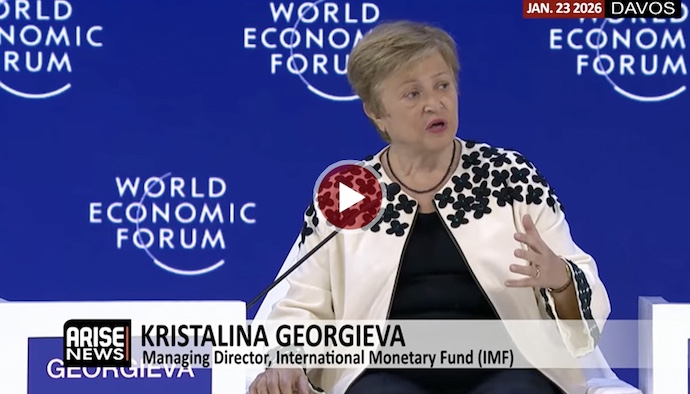
"First, there is a substantial shift in the demand for skills. Over the coming years, we anticipate that 60% of jobs in advanced economies will be impacted by AI, whether through augmentation, elimination, or transformation; globally, this figure stands at 40%. This is akin to a tsunami striking the labor landscape.
"Secondly, on a micro-level, we are monitoring job developments, and it's evident that within advanced economies, approximately one in ten jobs are already being enhanced, leading to higher wages for those occupying these roles. Higher earnings result in increased spending within local economies, including expenditure on dining out and various services. Consequently, the demand for low-skilled positions rises, and total employment appears to witness a modest increase. However, two significant challenges arise. The first is that roles that are being phased out predominantly comprise entry- level positions, making it more challenging for young individuals seeking employment to secure favorable placements. The second issue is that jobs unaffected by AI are experiencing stagnant or even decreasing wages. As a result, the middle class is left in a precarious situation.
"The third observation, which causes me the greatest concern, revolves around the absence of safeguard mechanisms,” she added.
Georgieva emphasized that the rate of AI integration is surpassing society's capability to manage it in a safe and inclusive manner. “This evolution is progressing rapidly, and yet, we lack the frameworks necessary for its safe implementation and inclusivity.
"Thus, I urge everyone to be aware. AI is not just a concept but a very real force that is accelerating transformation in our world, faster than we are able to adapt to it.
Her warning coincides with unprecedented levels of global debt, which are exacerbating economic risks amid this technological upheaval. Georgieva called on policymakers, enterprises, and laborers to take swift action to navigate the significant changes that AI will soon bring.
Comments (0)
You must be logged in to comment.
Be the first to comment on this article!