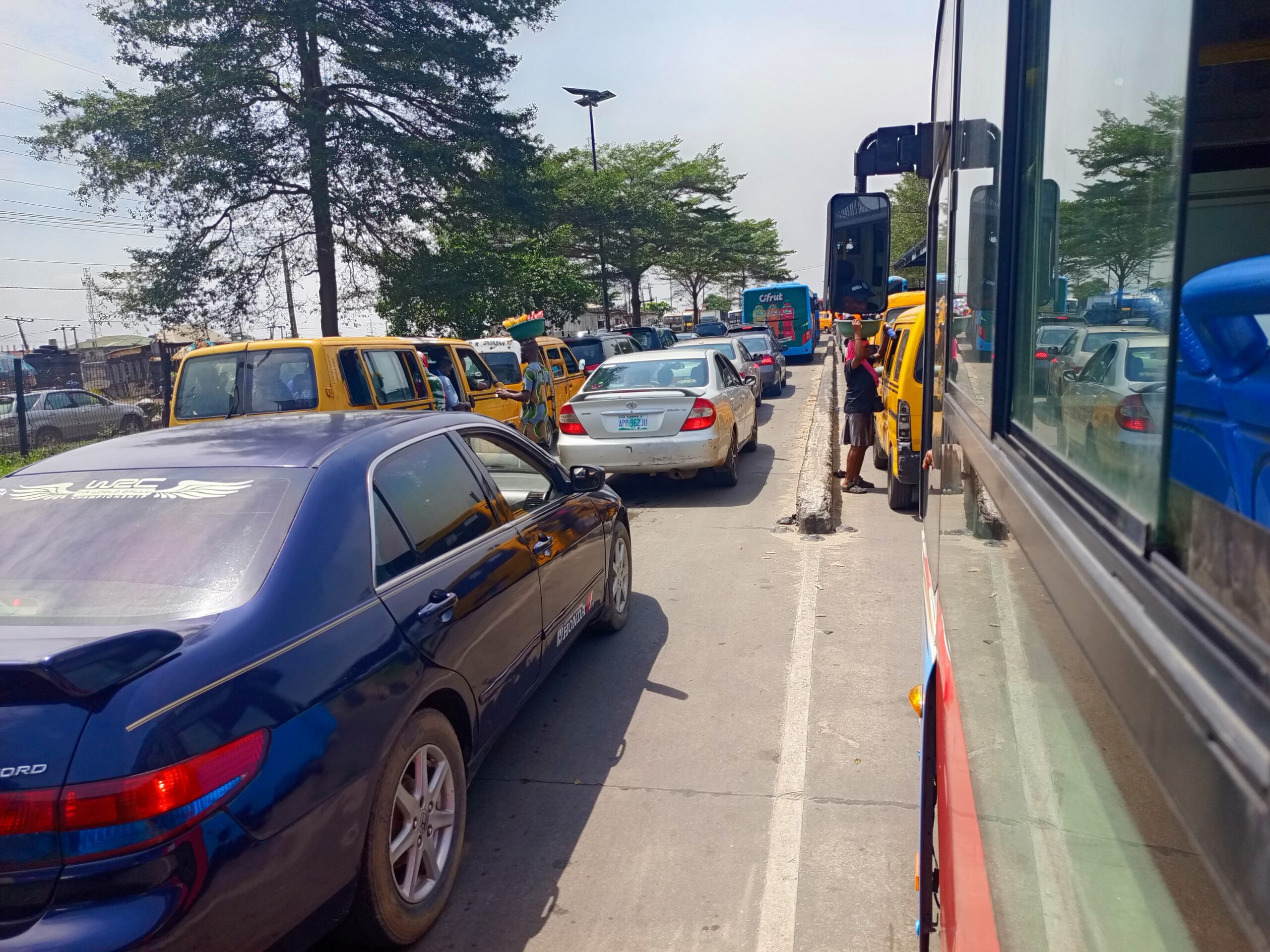
Commuters navigating the Bus Rapid Transit system along Ikorodu Road in Lagos State suffered extensive delays on Friday and Saturday after private motorists and commercial drivers unlawfully encroached upon the exclusive lanes. The obstruction left many travelers trapped in severe queues, completely undermining the primary advantage of the mass transit network designed to bypass highway gridlocks.
A commuter who boarded a transit vehicle from the Ikorodu terminal around 11 a.m. on Friday bound for Fadeyi did not arrive at Palmgrove until approximately 2 p.m. Observers noted heavy gridlock stretching from Agric through Owode, Ogolonto, and M12 towards Ketu, driven by unauthorized vehicles clogging the corridor and halting public transit movement. For instance, individuals who joined the queues at the Ikorodu terminal around 10:15 a.m. remained stranded near Ogolonto by 11:24 a.m.
Conditions worsened significantly on Saturday, as both inbound and outbound pathways along the Lagos route suffered total gridlock, preventing mass transit vehicles from maintaining regular schedules. Observers also documented security personnel attached to the Owutu Police Division actively assisting civilian drivers seeking entry into the restricted path, while officials from the Lagos State Traffic Management Authority were absent from the corridor during the hours monitored.
What is the official policy on the corridor?
The transit lane is established to grant absolute priority to high-capacity public passenger fleets, thereby cutting down travel times across the metropolis. However, the widespread intrusion during the two-day period completely disrupted this objective. In a recent official statement, the Lagos Metropolitan Area Transport Authority reaffirmed that the dedicated path is strictly reserved for authorized mass transit vehicles and approved state operators.
Authored by LAMATA’s Head of Corporate Communication, Kolawole Ojelabi, the notice clarified that private automobiles, select military and paramilitary units, alongside local municipal buses, are barred from utilizing the route. The agency stressed that emergency response assets, such as fire trucks and ambulances, remain the sole exception during active emergency responses.
What are the penalties for violations?
Authorities cautioned that unauthorized transit disrupts schedules, intensifies highway congestion, and poses severe safety hazards to passengers and pedestrians alike. The administration warned that enforcement protocols remain active, making violators liable to arrest and prosecution under state transport codes regardless of their official standing or affiliation.
Enforced sanctions encompass financial penalties, vehicle confiscation, and other legal actions. LAMATA has consequently called upon civilian drivers, security personnel, and public organizations to adhere strictly to regulations governing the corridor.
Mr. Ojelabi confirmed via text communications that established guidelines clearly outline eligible vehicles, noting that a specialized enforcement unit operating under the Special Adviser to the Governor on Transportation has been deployed to enforce compliance. He added that the agency is actively engaging with traditional leaders, security agencies, and media platforms to foster public cooperation and obedience to state traffic laws.
Background on the transit initiative
The dedicated transport path operates as an exclusive highway lane meant for high-capacity public carriers to bypass general gridlock. These fleets are managed through a public-private partnership framework involving the state government and licensed franchise operators. The pioneer transit system and dedicated corridor in Lagos officially commenced operations on 17 March 2008.