
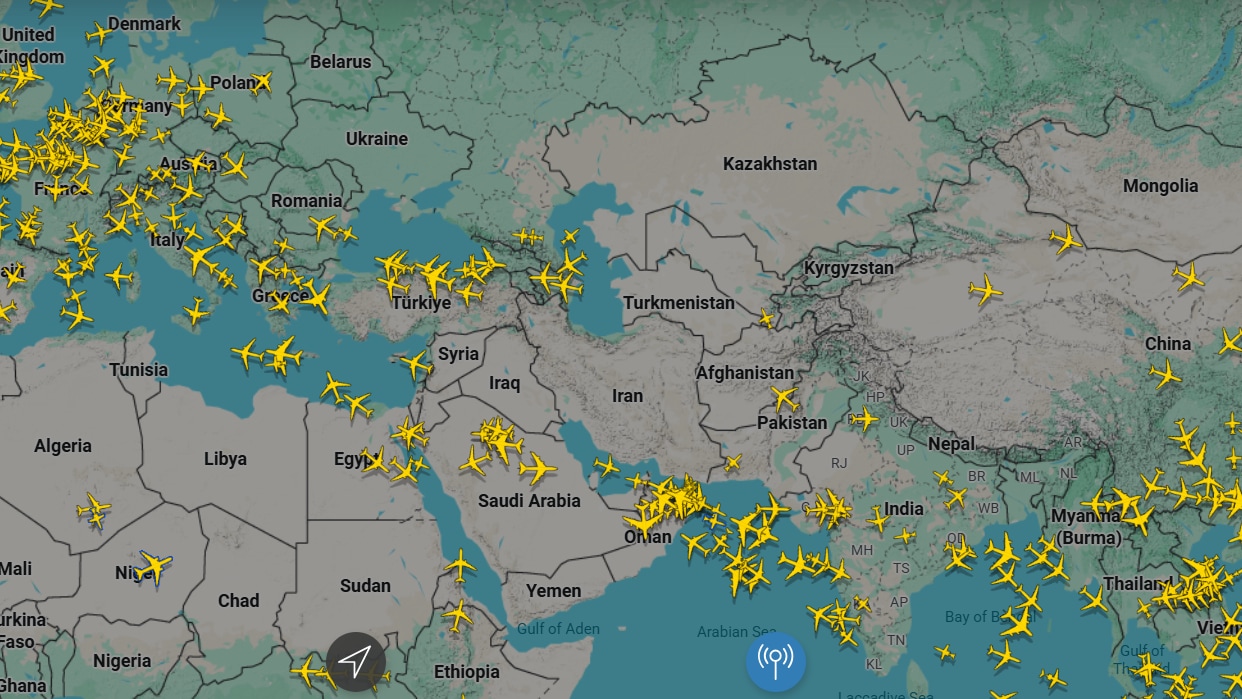
Much of the airspace in the Middle East has been closed, causing significant disruption to international flights following coordinated military strikes by the United States and Israel against Iran on Saturday, February 28.
The offensive was described as a 'pre-emptive' strike aimed at Iran's ambitions to develop nuclear weapons, triggering immediate retaliation from Iran with missile attacks targeting Israel and other nations in the region.
In the wake of these airstrikes, numerous countries announced the suspension of civilian air traffic as a security measure:
\- Iran has closed its entire airspace indefinitely, leading to a halt in all civilian flights.
\- Israel also shut down its airspace for civilian flights after targeting Iranian sites.
\- Iraq and Kuwait confirmed total airspace closures.
\- The United Arab Emirates (UAE) implemented a temporary partial closure of its airspace as a precaution.
\- Qatar and Bahrain suspended commercial flights due to escalating threats and regional instability.
\- Jordan and Syria imposed airspace restrictions in certain areas for safety.
Flight tracking reports indicated that a large segment of Middle Eastern airspace was nearly empty, as commercial flights were rerouted or grounded while airlines scrambled to adapt to the evolving situation.
Airlines such as Air France, Air India, Turkish Airlines, Norwegian, Air Algerie, and Lufthansa announced extensive flight cancellations due to the chaos.
According to FlightAware, as of 10:30 GMT, over 9,600 flights had encountered delays globally, and more than 500 flights were canceled worldwide due to these developments.
Comments (0)
You must be logged in to comment.
Be the first to comment on this article!