
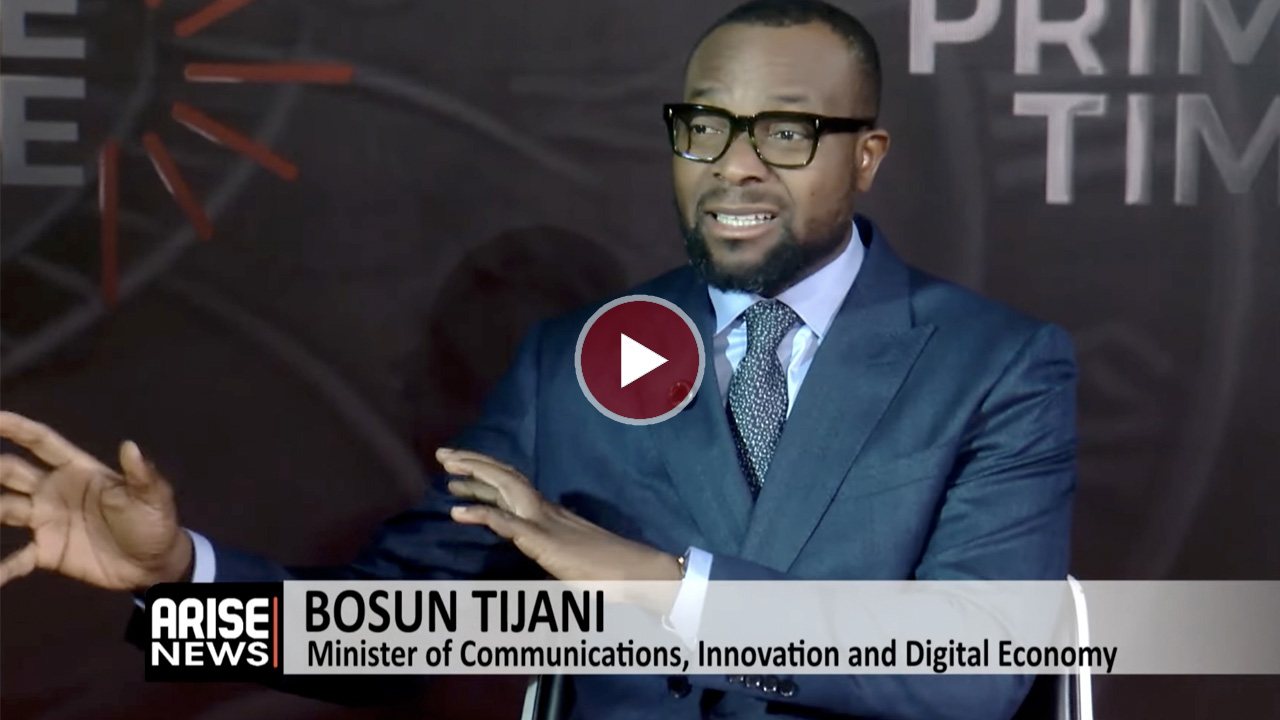
Bosun Tijani, Minister of Communications, Innovation, and Digital Economy, has asserted that the prosperity of Nigeria’s digital economy is rooted in connectivity and the active participation of local researchers in generating valuable insights for development across the nation.
Tijani made these remarks during an interview with ARISE NEWS on Tuesday.
He stated, "The foundation of nearly all our aspirations lies in infrastructure, whether that be physical or digital in nature. It is evident that there cannot be a strong economy without connectivity. Commerce, media, and education all hinge on it."
He urged the need to engage local researchers to monitor these developments, engage in research, and share their findings.
Elaborating further, Tijani noted that demand for internet access has escalated significantly, outpacing the growth of infrastructure, which has resulted in slower connectivity and performance issues, despite ongoing investment.
"In the past decade, the data consumption among Nigerians has soared, with projections indicating an increase of around 90 times compared to ten years ago. This growth reflects an overwhelming desire for connectivity driven by new content—such as online banking and social media platforms like WhatsApp. However, the investment in infrastructure has not kept pace with the demand for connection, which is primarily infrastructure-dependent," he detailed.
As for the government's role in bolstering connectivity within the country, Tijani mentioned that it is actively fostering the deployment of high-quality internet through strategic investments in partnership with the private sector.
He explained, "Historically, we have seen the private sector take the lead on investments. However, it’s rare to find any country, not even the developed ones, that can fully meet the demands for connectivity and consumption without some level of governmental facilitation."
Furthermore, Tijani discussed a potentially transformative project in which the government plans to cover nearly half of the funding needed to lay 90,000 kilometers of fiber. He noted that such an extensive network will reach every geopolitical zone, state, local government area, and ward throughout Nigeria, aiming to be completed in three to five years.
Significant progress is already underway, with the World Bank spearheading the initiative and the government contributing more than $850 million to the project. The minister called for private sector participation to bridge the funding gap, asserting that this project will not be under direct government management, as it is not within the government's purview to manage infrastructure.
Emphasizing internet safety, Tijani pointed out that research is essential to ensure that internet access is secure, inclusive, and beneficial to the populace.
"As we roll out this 90,000 kilometers of fiber, we must also engage our academic researchers to focus on issues surrounding online safety. We must consider who is looking out for the safety of our youth as they increasingly access the internet, he stated."
Moreover, he highlighted the distinction between mere connectivity and 'meaningful connectivity,' urging the need to analyze whether individuals are receiving real benefits from the services they subscribe to.
"Our objective is to ensure that technology is user-friendly and developed based on sound, evidence-based research, while also considering the societal benefits that can arise from it—aligning it with government objectives, which often stem from political perspectives," the Minister affirmed.
Tijani elaborated that funding will support researchers in conducting comprehensive studies and providing insights that will inform the policies shaping Nigeria’s digital economy.
He announced the establishment of six research clusters, with an allocation of $1.5 million for each cluster over the next three years. Each cluster will be led by a distinguished academic from various institutions, creating a total of 36 researchers dedicated to each topic. These resources will allow them to recruit postdoctoral researchers alongside PhD students to ensure that their research not only contributes to academic knowledge but also informs practical policy-making and commercialization efforts.
He stressed that the financial support is structured as a client-supplier relationship rather than a simple allocation of funds.
Addressing the need for user-centered designs for digital projects, Tijani asserted that the focus should prioritize practical solutions over mere aesthetics or functionality.
"Our designs should prioritize the users’ needs. While aesthetics and functionality remain important, if they do not address a genuine problem or enhance the user experience, then they fail to serve their intended purpose," he remarked.
The Minister also observed that as technology continues to evolve, emphasis has shifted towards creating holistic experiences, ethical systems, and considering the long-term impacts of new technologies.
"We are no longer just in the business of developing products or apps; we are crafting experiences and systems with an emphasis on ethics and sustainability, contemplating the question of whether we should build something, and the long-term ramifications of such decisions," he noted.
Furthermore, Tijani underscored the importance of ensuring that technology remains human-centric, advocating for a responsibility among designers to balance innovation with user privacy and ethical considerations.
"Consider smart home devices. They can be designed to execute various tasks, but we must ponder whether they should be constantly monitoring. We must find a balance between convenience and privacy. It is our duty as designers to champion user rights, even when it's challenging. We have the opportunity to cultivate a future that prioritizes human needs and accountability," he concluded.
Comments (0)
You must be logged in to comment.
Be the first to comment on this article!