
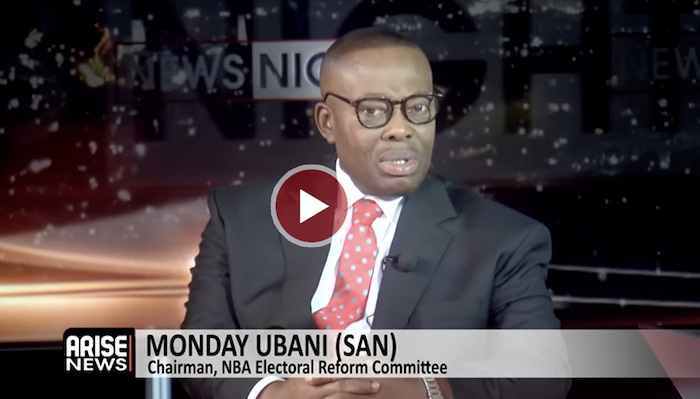
The chair of the Nigerian Bar Association's (NBA) Electoral Reform Committee, Monday Ubani, SAN, has stated that it is essential for the Senate to prioritize the Electoral Act Amendment Bill in order to avoid jeopardizing the preparations for the 2027 elections.
In a discussion with ARISE News on Tuesday, Ubani expressed concerns about the timeline for the general elections, emphasizing that without the amendment, key election dates would be uncertain.
"They went on recess in December, and they are set to resume this January. The Electoral Amendment Bill is among the top priorities awaiting action upon their return," Ubani noted.
"Every participant in the electoral process hopes that this bill gets passed, as the absence of an appropriate legal framework hampers the ability to set the election schedule for next year."
While the House of Representatives approved its draft of the amendment bill in December 2024, no action has been taken by the Senate. Ubani indicated that once the Senate reviews it, both legislative bodies will reconcile their versions before forwarding the bill to the President for approval.
"When the Senate finalizes their version, they will synchronize the bills and submit them for the President’s approval," he stated.
"I have confidence, based on my communications with key stakeholders, particularly within the Senate, that they will prioritize this matter."
Ubani clarified that a significant aspect of the proposed changes involves restructuring election timelines, with the aim of reducing the duration for contesting election results and potentially resolving disputes before the inauguration of elected officials.
He remarked, "The guidelines were not solely aimed at leadership considerations but also at managing electoral disputes."
"Certain timeframes for challenging election outcomes are being shortened. Discussions are ongoing about the feasibility of concluding electoral disputes before officially declaring winners."
One crucial reform suggested includes the mandatory real-time electronic transmission of election results to eliminate the confusion that marred the 2023 elections.
"You are familiar with the issue of real-time result transmission, which is of utmost importance," Ubani stated.
"This time, it needs to be treated as a requirement rather than merely a guideline. Results should be communicated once they are tallied at the polling station."
Ubani pointed out that the amendment also seeks to rectify gaps in the 2022 Electoral Act that led to varied judicial interpretations.
"There were numerous ambiguities in 2022, particularly regarding judicial interpretations," he remarked.
"These ambiguities will be addressed by rendering previously optional guidelines mandatory, which includes digitization, use of BVAS, and online submissions to IReV."
He also shared that the bill aims to amplify the authority of the Independent National Electoral Commission (INEC), especially in overseeing party primaries.
"More responsibilities have been handed to INEC to oversee the entire electoral process, from primaries to the general election," he explained.
"The lists of voters and delegates must be made public; it is crucial that hired outsiders do not cast votes, but rather individuals who are officially recognized as party members."
Furthermore, he noted that INEC’s regulations will now possess stronger legal reinforcement.
"Previously, some of INEC's regulations were not acknowledged under the law," Ubani indicated.
"Now, any guidelines promulgated by INEC will have constitutional support, which is crucial."
Ubani revealed that the amendment aims to curtail the campaign period, thereby mitigating excessive political expenses.
"A campaign period extending nearly a year is excessive, imposing unnecessary financial burdens on candidates," he remarked.
"Presidential campaign activities will likely begin around November, culminating in February elections, thus minimizing time and costs associated with campaigning."
Addressing the perception that the Senate lacks urgency regarding the bill, Ubani stressed that any delays are not deliberate.
"The Senate is not intentionally stalling this bill to undermine the electoral system," he said.
"The delay was mainly due to the holiday season, and once they resume, the bill will be treated with urgency."
The Electoral Act Amendment Bill is poised to play a pivotal role in shaping the future of Nigeria’s 2027 elections; legal experts and civil society advocates caution that any further delays could hinder INEC's preparations and erode public trust in the electoral process.
Comments (0)
You must be logged in to comment.
Be the first to comment on this article!