
Former British Prime Minister Tony Blair, Mark Carney, the Prime Minister of Canada, and Marco Rubio, the U.S. Secretary of State, have been named as members of a newly established international entity designed to oversee the reconstruction of Gaza following extensive conflict.
This organization, referred to as the “Board of Peace,” is under the leadership of U.S. President Donald Trump and is a critical component of a U.N.-supported American strategy aimed at demilitarizing Gaza and rehabilitating the region after the prolonged struggles involving Israel and Hamas.
U.S. officials indicate that the board will direct long-term stabilization initiatives and manage international investment and development ventures in Gaza. Among its initial members are Trump’s special envoy Steve Witkoff, deputy national security adviser Robert Gabriel, his son-in-law Jared Kushner, investor Marc Rowan, and World Bank president Ajay Banga.
Numerous global leaders have acknowledged receiving invitations to join this board. Canadian representatives confirmed that Prime Minister Carney has accepted his role. Turkey's presidential office stated that President Recep Tayyip Erdogan has also received an invitation, while Argentina's President Javier Milei publicized his acceptance as a founding member. Egypt reported that President Abdel Fattah el-Sisi has been invited and is currently considering it.
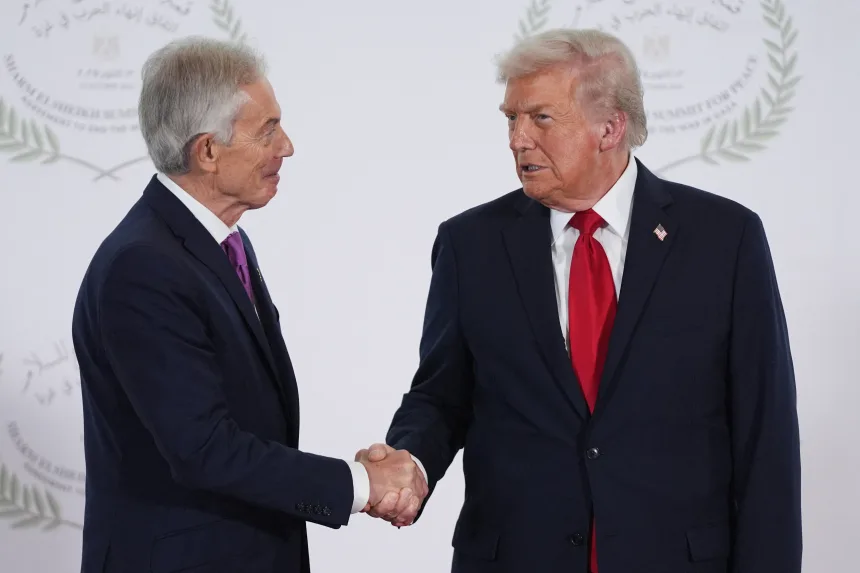
Trump referred to this panel in social media posts as an unprecedented assembly of global power, labeling it as the most distinguished international board ever gathered. The White House asserted that each member would have a distinct responsibility seen as vital for Gaza's recovery and future governance.
Interestingly, there is no representation from the Palestinian Authority on the board, which administers some areas of the occupied West Bank and is anticipated to take governance of Gaza after reforms. This absence has garnered criticism from the Palestinian militant group Islamic Jihad, which claims the board is designed to serve Israeli interests and is being tailored to conform to Israeli requests.
The appointment of Blair has generated notable scrutiny. His decade-long tenure as the U.K. leader has left a contentious legacy in the Middle East, primarily due to Britain's involvement in the Iraq war and his later role as a regional envoy, during which many Palestinians accused him of bias towards Israel.
According to the U.S. plan, day-to-day governance in Gaza will be administered by a distinct 15-member technocratic Palestinian committee. This committee will be led by Dr. Ali Sha’ath, a Palestinian from Gaza who has prior experience with the Palestinian Authority. Their mission encompasses the restoration of essential services and the rebuilding of significant institutions to stabilize civilian life.
Former U.N. Middle East peace coordinator Nickolay Mladenov has been appointed as the high representative for Gaza, serving as a liaison between the technocratic committee, the Board of Peace, and regional stakeholders.
The framework indicates that the technocratic committee will oversee Gaza temporarily until a restructured Palestinian Authority can assume control, paving the way towards what the plan describes as a credible avenue for Palestinian self-determination. Israeli Prime Minister Benjamin Netanyahu has vehemently opposed any role for the Palestinian Authority in Gaza and has dismissed the notion of Palestinian statehood.
Israeli officials have stated that the country exerted considerable influence over the selection of the committee members, insisting that individuals linked to Hamas or the Palestinian Authority be excluded from the list. It has been reported that Israel’s internal security agency endorsed all 15 appointments.
Additionally, a separate Gaza executive board has been created to bolster governance efforts, consisting of representatives from Turkey, Qatar, Egypt, and the United Arab Emirates, as well as members from the Board of Peace and the technocratic committee.
Israel has condemned the establishment of this executive board, asserting that its formation was not coordinated with Israeli authorities and contradicts official policies. Netanyahu has directed Foreign Minister Gideon Saar to discuss Israel’s concerns directly with Rubio.
Comments (0)
You must be logged in to comment.
Be the first to comment on this article!