
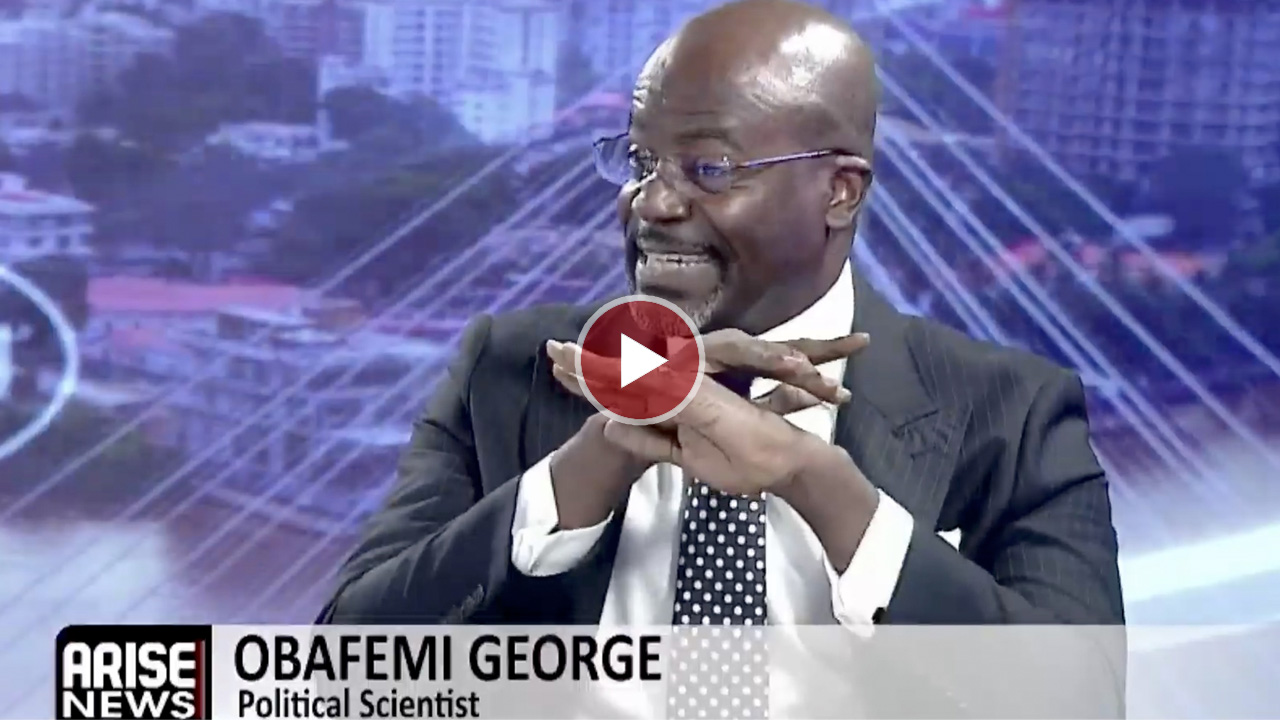
Political scientist Obafemi George has firmly stated that there is no factual basis to support claims that the ruling All Progressives Congress (APC) is behind the crises plaguing opposition parties.
During an interview on ARISE NEWS on Thursday, George labelled these allegations as inaccurate and cautioned against the increasing spread of unsubstantiated claims originating from social media.
"I believe that accusation is false, and let me explain why," George stated. "We are witnessing a developing pattern in our political discourse where verifiable facts are disregarded. A false narrative is introduced, gains traction on social media, and rapidly disseminates without proper examination."
He contended that, contrary to the accusations, opposition parties have themselves fallen short of public expectations. George highlighted the absence of any concrete proof connecting the APC to the internal conflicts within parties such as the African Democratic Congress (ADC).
"Let's focus on the facts. No one has presented even a shred of evidence to demonstrate that the APC has influenced the events occurring within the ADC," he asserted.
George drew parallels with historical events, recalling past instances where ruling parties faced accusations of weakening opposition movements. He emphasized that, in those cases, such allegations were substantiated by demonstrable evidence.
"In 2003, when opposition governors in the South-West were removed, there were documented facts. In 2007, even President Umaru Musa Yar'Adua acknowledged flaws in the process that led to his election. In 2014, concerning the Ekiti election, video and audio evidence of electoral manipulation emerged. These were allegations supported by evidence," he recounted.
Regarding the internal challenges within the ADC, George pointed to what he described as breaches of the party's constitution, particularly concerning the duration of leadership.
"The ADC's constitution explicitly limits party officials to a four-year term, with the possibility of one renewal. However, Ralph Nwosu served as chairman from 2005 to 2025 – a total of 20 years. By their own constitution, any tenure beyond 2013 was illegitimate," he argued.
He reiterated that opposition parties are primarily responsible for their own instability, attributing it to internal decisions and structural deficiencies.
"All other parties have faltered due to their internal mechanisms. The APC cannot be blamed for this," he remarked.
Addressing concerns about Nigeria potentially transitioning into a one-party state, George dismissed the idea, maintaining that the current political landscape is a consequence of opposition party shortcomings rather than the dominance of the ruling party.
"It is not accurate that Nigeria is becoming a one-party state. These issues did not emerge recently," he said, referencing internal party disputes that predated the 2023 general elections.
Furthermore, George defended recent electoral reforms, especially the shift away from indirect primaries, asserting that these changes have enhanced the credibility of Nigeria's electoral system.
"This provision has eliminated the scenario where the wealthiest candidate could simply purchase delegates. It has strengthened the system," he noted.
On the performance of the Independent National Electoral Commission (INEC), George stated that the electoral body has acted within its constitutional authority to uphold the integrity of the election process.
"INEC is constitutionally mandated to conduct elections and implement measures that protect the system. Their actions are aimed at preventing a recurrence of situations like Zamfara in 2019, where court decisions overturned election results post-announcement," he clarified.
While acknowledging that perceptions and political influences can be debated, George insisted that political arguments must be firmly rooted in verifiable evidence.
"When discussing politics, one cannot build an argument on mere perception. It must be evidence-based. This is why it is termed political science – it is a scientific discipline, not an art," he concluded.
He underscored that opposition parties must accept accountability for their internal difficulties instead of attributing them to external interference.
Comments (0)
You must be logged in to comment.
Be the first to comment on this article!