
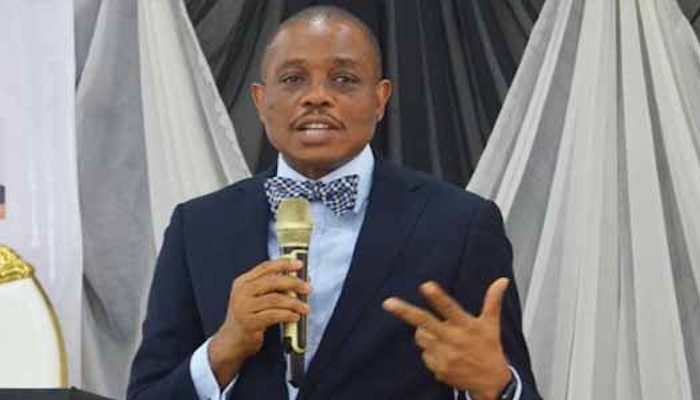
Mazi Afam Osigwe, SAN, who serves as the President of the Nigerian Bar Association (NBA), has expressed serious worries regarding the tarnished image of the judiciary in Nigeria. He warned that the views held by the public pose a significant risk not only to democracy but also to the nation as a whole.
In his remarks, the NBA president referenced various reports indicating that judges and lawyers are regarded as two of the most corrupt individuals in Nigeria, suggesting that monetary influences, often described as the "fatness of envelopes," are favored over evidence in the quest for justice.
Osigwe made these assertions during a speech at the Ralph Opara Memorial Lecture held in Enugu, which was organized by the National Association of Seadogs. The lecture was titled "Judicial Corruption in Nigeria: A Menace to Democracy and Social Justice."
He characterized the current state of the judiciary as a "moral crisis and a democratic emergency" that threatens the ideological foundations of Nigeria. Osigwe noted, "The judiciary, once esteemed as the ultimate refuge for the common man, is now increasingly seen as a marketplace where justice is sold to the highest bidder."
The NBA president further lamented the pervasive disillusionment among citizens who now perceive courtrooms as venues where judicial decisions are swayed by bribes rather than by the merits of the cases presented.
Quoting a 2024 survey conducted by the UNODC and the National Bureau of Statistics, Osigwe pointed out that public officials were reported to have received around N721 billion in cash bribes in 2023, with judges being among the leading participants.
He referred to an ICPC survey revealing that N9.4 billion in bribes circulated within the judicial sector from 2018 to 2020, identifying lawyers and litigants as the main contributors to these corrupt practices.
Osigwe stated that the decay within the judiciary has severely undermined public trust, adding that the 2024 Corruption Perceptions Index released by Transparency International ranked Nigeria 140th out of 180 countries.
He cautioned that a justice system plagued by corruption allows the affluent and powerful to evade accountability, while the less privileged face the harshest consequences.
Pointing to international implications, Osigwe highlighted instances such as Okpabi v. Royal Dutch Shell, where communities from the Niger Delta sought justice in UK courts due to a lack of effective legal recourse in Nigeria. He also mentioned the P&ID; arbitration case, noting that a significant financial ruling against Nigeria was only overturned in London after evidence of fraud was established.
"These cases serve as a global statement of no confidence in Nigeria’s legal framework," he remarked.
To combat judicial corruption, Osigwe called for comprehensive reforms, which should involve merit-based appointments for judicial positions, the establishment of judicial academies at the state level, and the removal of the Chief Justice of Nigeria from the National Judicial Council chair to avert the concentration of power.
He advocated for automated case management systems, mandatory suspensions for judges facing investigations, and full realization of judicial financial autonomy.
“The fight against corruption is a collective duty for the Bar, the Bench, and the populace,” Osigwe urged, recommending that religious and traditional institutions refrain from honoring individuals with questionable sources of wealth.
"Future generations will evaluate us not by our words, but by our willingness to take action. The justice system must be purified to ensure that the rule of law prevails over monetary influence," he asserted.
He emphasized that the sustenance of Nigeria’s democracy relies heavily on an incorruptible judiciary that earns respect both domestically and globally.
Comments (0)
You must be logged in to comment.
Be the first to comment on this article!