
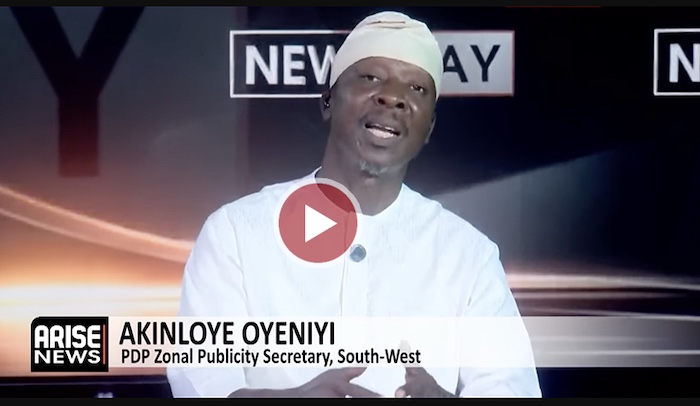
Akinloye Oyeniyi, the South-West Zonal Publicity Secretary for the Peoples Democratic Party (PDP), has raised significant concerns regarding the Oyo State government's recent installation of traditional rulers in Ibadan, characterizing the procedure as a departure from established norms.
During an interview with ARISE News on Monday, Oyeniyi conceded that while the state administration possesses the legal prerogative to appoint traditional leaders, the method employed for the recent ceremonies was unusual.
"The installation of traditional rulers falls within the legal purview of the state government. However, proceeding with the installation of someone in their absence is unprecedented," he stated.
He highlighted the omission of crucial coronation elements, such as the formal presentation of the staff of office and the placement of crowns on the heads of the newly appointed monarchs.
"Neither a staff of office nor a crown was presented," he added.
Oyeniyi further pointed out that the affected chiefs had reportedly requested a postponement of the ceremonies, a plea that the government apparently disregarded.
He suggested that the timing of these installations might be influenced by political considerations currently unfolding within the state.
"These positions had been sought for a considerable period, and the state government's action came recently, following whispers of a potential All Progressives Congress (APC) candidacy," he commented.
Regarding the potential for strained relations between Governor Seyi Makinde and the Olubadan of Ibadan, Oyeniyi acknowledged that while both parties have publicly denied any conflict, the circumstances surrounding the installations suggest otherwise.
"The government's decision to proceed without the Olubadan's presence... indicates a different reality," he remarked.
He stressed that the presence of other high-ranking chiefs cannot substitute for the Olubadan's authority in such significant traditional events.
"The attendance of the Balogun is not equivalent to the Olubadan's endorsement," he clarified.
Despite the ongoing controversy, Oyeniyi downplayed fears of widespread instability within the state, asserting that constitutional provisions remain the paramount guiding principle.
"This situation does not necessarily pose a threat to stability... the 1999 Constitution is the supreme law," he affirmed.
He explained that holding a traditional title does not automatically disqualify an individual from pursuing political ambitions, provided they meet all constitutional requirements.
Responding to assertions that the controversy is being overblown, Oyeniyi maintained that both the political undercurrents and the procedural irregularities make it a matter of serious concern.
"The issue has two facets: the political motivations and the flawed execution of the coronation," he articulated.
He further criticized the ceremony, describing it as lacking in proper formality and structure.
"It resembled more of a 'jamboree'... one cannot impose an installation on an individual who is not prepared," he stated.
On the matter of potential reforms, Oyeniyi asserted that the existing legal frameworks are adequate, provided they consistently align with constitutional mandates.
"Any customary laws or official actions must be in harmony with the Constitution," he emphasized.
Oyeniyi's observations highlight significant concerns about due process in matters of traditional leadership, suggesting that while legal compliance may exist, true legitimacy is founded upon adherence to established customs and procedures.
Comments (0)
You must be logged in to comment.
Be the first to comment on this article!