
Saif al-Islam Gaddafi, son of Libya’s ex-leader Muammar Gaddafi, has reportedly been killed at his home in Zintan. This tragic event has spurred officials to call for an immediate investigation into the circumstances surrounding his death.
According to his lawyer Khaled al-Zaidi and his political adviser, Abdulla Othman, the news of the 53-year-old's demise was shared via Facebook posts on Tuesday. However, specifics regarding the incident were limited.
Reports from the Libyan news channel Fawasel Media indicate that armed attackers entered Saif al-Islam Gaddafi's residence and fatally shot him. This incident took place in Zintan, roughly 136 kilometers southwest of the Libyan capital, Tripoli.
Gaddafi's political associates have characterized the killing as a deliberate attack, labeling it a "cowardly and treacherous assassination." They disclosed that a group of four masked individuals raided his home and shot him, claiming that Saif al-Islam confronted his killers just before he was shot.
The statement released by his political team detailed that the assailants attempted to disable security cameras to erase any evidence of their crime, indicating a well-planned assault.
In the wake of the incident, Khaled al-Mishri, who previously chaired the Tripoli-based High State Council, underscored the urgency of conducting a thorough investigation into Gaddafi’s death.
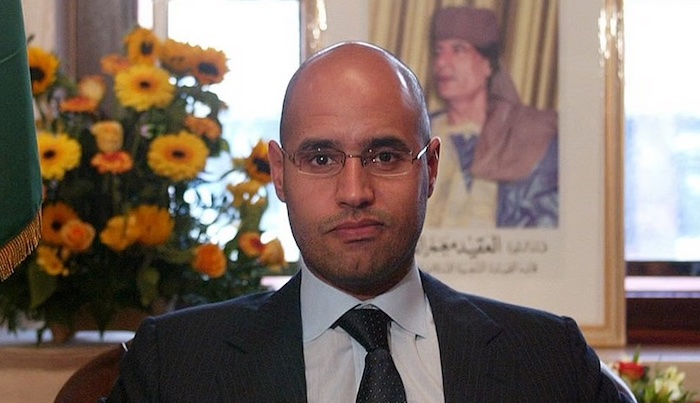
Although he never held an official government position, Saif al-Islam was perceived as his father's second-in-command from 2000 until 2011, a period that ended with the demise of Muammar Gaddafi at the hands of opposition forces, concluding over four decades of rule.
He was detained in Zintan in 2011 while trying to escape Libya following the capital's fall and had been held by a local militia until his release in 2017 under a general amnesty, thereafter residing in Zintan.
Gaddafi was well-educated in the West, speaking fluent English, and was often seen as the public representative of potential reforms within his father’s dictatorship. He was instrumental in reviving Libya’s relations with Western nations during the early 2000s.
In earlier years, he played a significant role in negotiations that led Libya to abandon its arsenal of weapons of mass destruction and was involved in settling compensations for the families of victims from the 1988 bombing of Pan Am Flight 103 over Lockerbie, Scotland.
A graduate of the London School of Economics, he purportedly promoted himself as a reformist advocating for constitutional governance and respect for human rights, publishing a dissertation focused on civil society’s role in improving global governance.
However, during the 2011 uprising against his father's regime, Saif al-Islam shifted from his reformist stance, actively participating in the brutal crackdown of protests and using derogatory terms to describe dissenters.
In an interview with Reuters amidst the uprising, he declared, “We fight here in Libya, we die here in Libya,” warning that the situation would devolve into chaos, stating that “rivers of blood” would flow and asserting that the regime would fight until the end.
Throughout this time, he was accused of employing torture and extreme violence against his father's opponents. By February 2011, he found himself on a United Nations sanctions list, restricting his international mobility.
He was also pursued by the International Criminal Court for alleged crimes against humanity during the uprising. After rebel forces took control of Tripoli, he attempted to flee to Niger disguised as a Bedouin but was captured by the Abu Bakr al-Sadiq Brigade in the desert and subsequently taken to Zintan.
Following extensive negotiations, Libyan authorities were permitted by the ICC to prosecute him domestically. In 2015, he received a death sentence in absentia for war crimes from a Tripoli court.
After regaining his freedom in 2017, he reportedly lived away from the public eye in Zintan, wary of assassination attempts.
In November 2021, Saif al-Islam Gaddafi announced his return to the political arena, declaring his intention to run in Libya’s protracted presidential election, a move that ignited backlash from anti-Gaddafi groups throughout the nation.
Despite his efforts, he was disqualified from the electoral race due to his 2015 conviction, and when he sought to appeal, armed groups blocked his access to the courts.
This contention over his candidacy became a significant trigger in the electoral process, leading to its eventual breakdown and a return to political stagnation in Libya.
Comments (0)
You must be logged in to comment.
Be the first to comment on this article!