
The Supreme Council for Shari’ah in Nigeria (SCSN) has once again urged for the dismissal of Joash Amupitan, the Chairman of the Independent National Electoral Commission (INEC), ahead of the 2027 general elections, characterizing him as a risk to the credibility of the democratic process in Nigeria.
The Council cautioned that Muslims would not recognize or validate any elections held under Amupitan’s oversight, citing significant concerns regarding his integrity and impartiality.
During the Council’s 2026 Annual Pre-Ramadan Lecture and General Assembly held on Tuesday in Abuja, with the theme “Nigeria’s Future: Faith, Justice, and Leadership,” Sheikh Bashir Umar, the President of SCSN, expressed these critical concerns.
Umar pointed out that the Council's position stems from what it described as the questionable background of the INEC chairman, specifically referencing a legal brief he purportedly authored which suggested a narrative of Christian genocide in Nigeria—an assertion that has been categorically dismissed by the Federal Government.
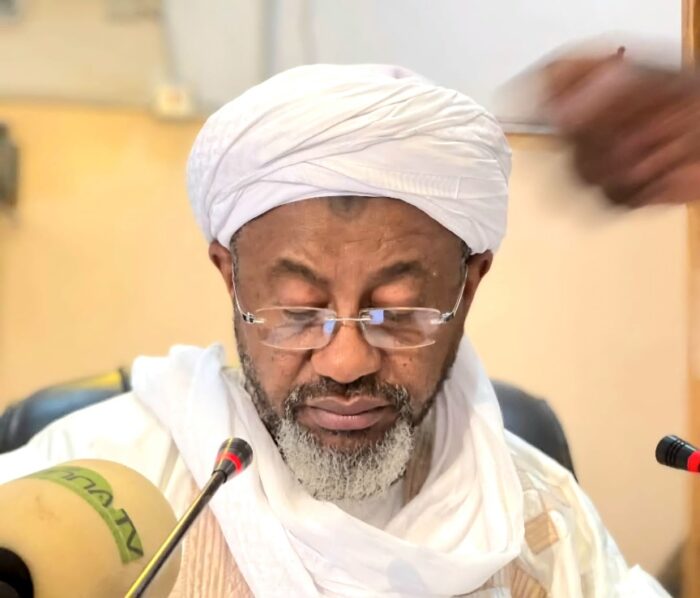
“This isn’t the first time the Council has voiced this concern,” said Umar. “In a legal document he sent personally, he attempted to assert that a Christian genocide occurs in Nigeria, contradicting the official position of the Federal Government, which clearly denies the existence of such a genocide.”
He further noted that the stance of the INEC chairman represented divisive propaganda, which raises doubts about his neutrality in overseeing elections.
“For an official presiding over a democratic process, integrity and impartiality are crucial,” Umar emphasized. “As we see it, his integrity has already been compromised. The honorable course of action would be for him to resign. Should he choose not to, the government ought to remove or retire him.”
In a response to these allegations, an official from the INEC dismissed the claims, stating the commission would not engage with the Council’s assertions, which they regarded as an attempt to gain public attention.
When inquired whether the SCSN intended to pursue legal actions, Umar clarified that the Council acts as an advocacy organization and is not directly involved in litigation. However, he mentioned that other organizations have already turned to the courts to contest Amupitan’s appointment and continued tenure in office.
“The community will not recognize or legitimize any elections presided over by someone with dubious integrity,” he asserted. “The credibility of democracy must not be compromised.”
Besides the electoral issues, the Council also expressed discontent over increasing insecurity, economic hardship, inadequate budget implementation, perceived inequities in federal appointments, and attempts to undermine Muslims' constitutional rights to practice Shari’ah in predominantly Muslim states.
Furthermore, the SCSN rejected the narratives of a Christian genocide in Nigeria, warning that such statements incite division and threaten national unity.
During the event, Aminu Sani Jaji, Chairman of the House of Representatives Committee on Ecological Funds, remarked on the significance of the timing of the Pre-Ramadan lecture, considering Nigeria’s prevalent security and socio- political challenges. He warned that unchecked and divisive narratives could exacerbate existing tensions if not handled responsibly.
The occasion's chairman, Mallam Muhammadu Munir Ja’afaru, the Madakin Zazzau, stated that the Council has remained a principled voice for the Nigerian Muslim community, advocating for justice, peaceful coexistence, and national unity through constructive engagement.
Comments (0)
You must be logged in to comment.
Be the first to comment on this article!