
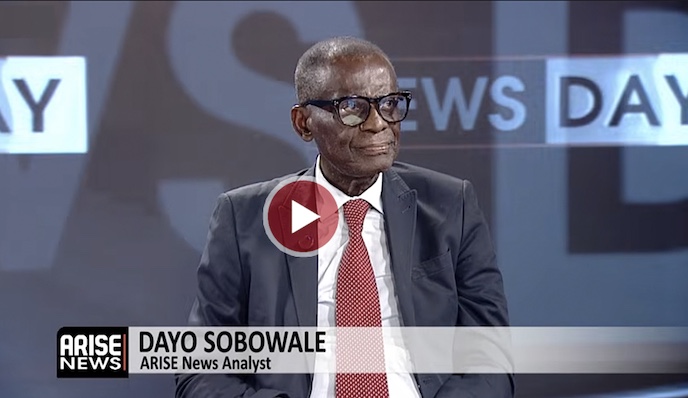
Dayo Sobowale, an analyst for ARISE News, has indicated that President Bola Tinubu's commitment to ensuring fair revenue collection from global technology corporations will significantly bolster Nigeria's media sector, enabling it to vie effectively in the rapidly evolving digital landscape.
During a discussion with ARISE News on Monday, Sobowale elaborated that the president's strategy extends beyond mere financial aid for media entities; its core objective is to guarantee the sustained existence of Nigerian media against the backdrop of dominant global technology companies.
He highlighted that global tech giants such as Apple and Amazon, along with other digital platforms, currently wield substantial influence over how news content is disseminated and monetized. This often leaves traditional media outlets struggling to achieve sufficient revenue generation.
"What he is attempting is more than just a discount," Sobowale commented. "He is working to position the Nigerian press for international competition and for survival within our economic sphere, resisting the monopoly exerted by Big Tech companies."
Sobowale further explained that numerous nations are currently grappling with the increasing dominance of large technology firms, observing that the global economic framework is progressively being shaped by these digital platforms.
"Someone once characterized the global economic system as a techno-feudal economy," he remarked. "It has reached a point where Big Tech corporations influence governments, markets, and security frameworks."
He suggested that the president's plan to implement tariffs and other economic measures designed to reduce production costs for media organizations could enhance the competitiveness of Nigerian news platforms.
"What he has initiated is to begin with tariffs to decrease our production expenses and enhance our competitiveness," Sobowale noted.
The analyst also advocated for enhanced collaboration between the federal government and local technology innovators to foster the development of indigenous digital platforms that can rival global tech companies.
"We have a Ministry of Innovation, Science and Technology," he stated. "That ministry ought to collaborate with newspaper and digital platform owners in Nigeria so that we can create our own domestic technologies."
Sobowale argued that Nigeria must concentrate on cultivating its local technological capabilities rather than depending solely on foreign digital platforms that currently dominate global communication systems.
"The appropriate course of action is to replicate or adapt what these established technologies are doing," he advised.
He also pointed out that even economically advanced nations in Europe have voiced concerns regarding what he termed "technological imperialism" perpetrated by major technology companies.
"Europe is raising objections," he said. "The European Union and the United Kingdom are expressing worries about technological imperialism and colonialism, similar to the practices they once engaged in."
Sobowale asserted that Nigeria must cultivate its own digital communication infrastructure to safeguard its economic and cultural autonomy.
"If others dictate how you think and what you search for, it will shape your market," he explained. "You might end up becoming secondary European imitators rather than Nigerians adapting technology to their own context."
He concluded that by strengthening Nigeria's digital ecosystem, the media industry will be better positioned to contribute more effectively to national progress and the functioning of democracy.
"We aim to achieve digital parity with the rest of the world in communication and in enabling the press to contribute meaningfully to our freedom and economic advancement," Sobowale stated.
Comments (0)
You must be logged in to comment.
Be the first to comment on this article!