
South Korean police have launched a raid at the offices of the transport ministry, intensifying scrutiny over the government's response to the country’s most devastating aviation tragedy to date.
On Friday, investigators from the police force searched the premises of the Ministry of Land, Infrastructure and Transport located in Sejong City. This action was reported by Yonhap News Agency and appears to be aimed at uncovering new evidence pertaining to the December 29, 2024 crash of Jeju Air Flight 2216.
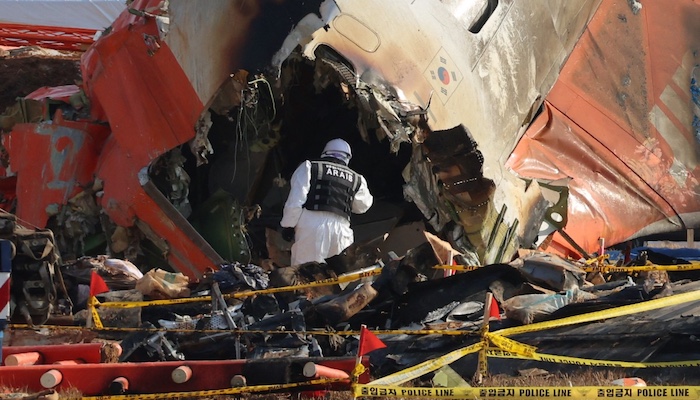
The Boeing 737-800, carrying 181 passengers, overran the runway at Muan International Airport, colliding with a concrete structure, resulting in the deaths of nearly all onboard, with only two flight attendants surviving the horrific incident.
Initial investigations indicated that shortly before landing, the aircraft suffered a bird strike. The impact with the concrete mound, situated near the runway, significantly aggravated the crash and subsequent fire.
This raid is part of a broader investigation into the catastrophe, with the final report anticipated by mid-2026. Concurrently, other investigations are also ongoing involving various government entities and lawmakers.
Public discontent has surged recently after the discovery of additional human remains and personal belongings of victims, which were found stored in sacks with debris removed from the crash site. Families of the deceased have been urging authorities for several months to reassess the wreckage.
In light of these findings, South Korean leader Lee Jae Myung has initiated a new investigation as of Thursday to determine the reasons behind the failure to identify the remains and belongings sooner. Lee has also called for officials responsible for the delayed recoveries to face disciplinary actions.
Although the transport ministry has extended an apology, families of the victims have dismissed this as inadequate, with spokespeople stating that the delayed government reaction feels like a secondary form of victimization.
Additionally, an inquiry by the Board of Audit and Inspection of Korea revealed that the concrete mound that the aircraft struck had been erected as a means of cutting costs.
Rather than leveling the terrain to accommodate a navigation antenna system, authorities opted to install the system's localizer equipment on an elevated concrete mound beside the runway due to the airport's sloping landscape.
Auditors suggested that such structures should be designed to disintegrate upon impact to minimize risk to aircraft.
Simulations indicated that, had the plane not collided with the solid structure, all occupants might have survived. Following a bird strike by migratory ducks, pilots managed to execute a belly landing, gliding along the runway until the aircraft collided with the concrete mound, which resulted in a catastrophic fire.
Comments (0)
You must be logged in to comment.
Be the first to comment on this article!