
Taiwan's opposition chief, Cheng Li-wun, is commencing a trip to China on Tuesday, with potential discussions with President Xi Jinping on the agenda. Cheng has characterised the visit as a peace mission, occurring at a time when China is actively pursuing strategies to garner support in Taiwan for eventual reunification.
As the chairwoman of the Kuomintang (KMT), Taiwan's largest opposition party, Cheng's visit coincides with increased military activity by China towards the self-governing island, which Beijing claims as its territory. The trip also follows a period where Taiwan's opposition-controlled legislature has delayed the approval of a substantial defence spending proposal amounting to $40 billion.
The KMT and Taiwan's ruling Democratic Progressive Party (DPP) have presented contrasting views on Cheng's visit, engaging in public debates and social media exchanges that highlight their differing perspectives on peace and security.
In a video shared on Sunday, the KMT emphasized that "Peace is the only foundation for prosperity, and the hope for Taiwan’s future," accompanied by visuals of young people enjoying leisure activities.
The DPP, however, expressed concerns in a Facebook post, suggesting that the KMT's actions align with Beijing's objectives. The party accused the opposition of aiming to "cooperate with the Chinese communists’ scheme to weaken Taiwan’s defence capabilities," referencing the delays in defence spending, which also has the backing of the United States.
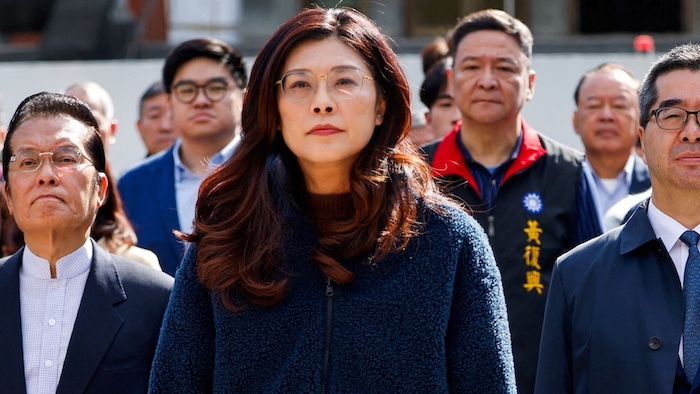
Cheng had previously stated to international journalists that diplomacy must be considered alongside military readiness. She argued that "Peace cannot possibly be achieved through defence capabilities alone," stressing the equal importance of political engagement.
Her visit is taking place shortly before a planned summit between US President Donald Trump and Chinese President Xi Jinping in Beijing. While the summit is expected to address certain trade and supply chain agreements, fundamental political disagreements, particularly concerning Taiwan, remain unresolved.
During a phone conversation in February, Xi Jinping advised Trump that the United States should "carefully handle arms sales to Taiwan."
This trip represents the first visit to China by a KMT leader in ten years, although Beijing has not yet confirmed if President Xi will meet Cheng, who is scheduled to be in Beijing from Thursday.
Taiwan's Mainland Affairs Council has advised Cheng to adopt a firm stance with Beijing during her visit. The council suggested she should call on China to cease its military provocations and "respect the Taiwanese people’s right to choose their own future."
Beijing has consistently refused to engage with Taiwan's current President Lai Ching-te, labelling him as a "separatist."
China's intensified messaging on 'reunification' is notable.
While China has not ruled out the use of force to bring Taiwan under its control, it continues to advocate for "peaceful reunification" as its primary strategy. In recent weeks, Beijing has increased its efforts to engage with various segments of Taiwanese society, measures that Taipei officials have rejected.
On Friday, China’s Eastern Theatre Command, responsible for potential military actions against Taiwan, released a cartoon that depicted "Taiwan province" during the Tomb Sweeping Festival, illustrating a vision of life post- reunification. The graphic featured individuals placing flowers at a "Monument for the complete reunification of the motherland," situated near Taipei’s Machangding Memorial Park, the site where communist spy Wu Shi was executed by KMT authorities in 1950.
The KMT's own origins date back to 1949, following its retreat to Taiwan after losing the Chinese civil war to Mao Zedong's Communist Party.
Despite Beijing's persistent efforts, public opinion polls conducted in Taiwan consistently indicate limited support for accepting Chinese sovereignty under the "one country, two systems" framework.
When questioned about "reunification" during a press conference with foreign correspondents, Cheng indicated that the prerequisites for such discussions have not yet been met. She stated, "What we need to deal with now is how to create peaceful and stable cross-strait relations."
Comments (0)
You must be logged in to comment.
Be the first to comment on this article!