
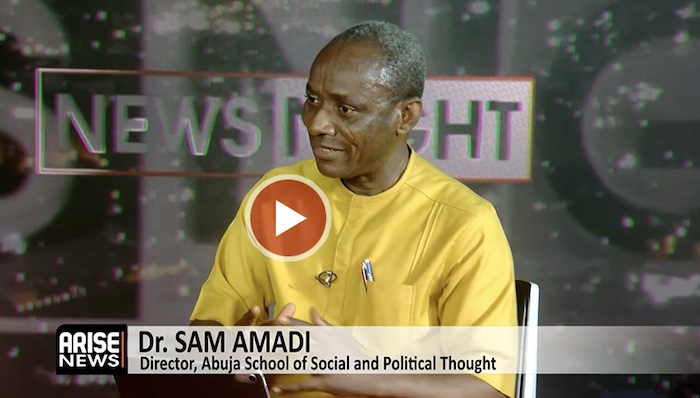
Dr. Sam Amadi, the Director of the Abuja School of Social and Political Thought, has expressed grave concerns about the Senate's attempt to alter the provisions regarding electronic transmission of election results, warning that it could lead Nigeria into a constitutional and democratic crisis.
In a recent interview with ARISE News, Amadi described the current debate surrounding the amendment of the Electoral Act as a perilous repetition of the previous missteps that severely undermined public trust in the 2023 general elections.
"This is a déjà vu," Amadi remarked. "Back in 2022, during discussions on the electronic transmission provision, every APC senator opposed it. What we are experiencing now is merely a resurgence of the same chaos."
He recalled that the compromise achieved in the 2022 Electoral Act enabled INEC (Independent National Electoral Commission) to decide the method of result transmission through its regulations, which was a typical legislative maneuver aimed at embracing technological advancements.
"The law intentionally provided room for INEC's discretion because electoral technology develops rapidly. INEC utilized this authority through its guidelines and regulations," he clarified. "If everything were functioning correctly, our focus would be on reinforcing that provision rather than reversing it."
Amadi articulated that the turmoil following the 2023 elections arose not from the legislation itself but rather from judicial misinterpretations and INEC's lack of robust defense of its regulations in court.
"The judicial system, including the Supreme Court, misjudged the situation," he asserted. "INEC notably failed to uphold the regulations it publicly committed to, even during a presentation at Chatham House in London."
He pointed out that the ongoing debate regarding result transmission has generated a persistent legitimacy crisis.
"Even today, many Nigerians consider the 2023 election illegitimate. This crisis stems from ambiguity, and now the Senate intends to exacerbate it," he stated.
Amadi rejected the notion that Nigeria lacks the technical capability for real-time result transmission, citing previous successes by INEC in conducting electronic transmission during earlier governorship elections.
"There is no confusion; there are no technical hurdles," he affirmed. "INEC successfully transmitted results electronically in governorship elections before 2023 without any issues."
He explained that the failure to transmit presidential results was due to inadequate preparation, not infrastructural limitations.
"In 2023, INEC did not properly prepare for the presidential result uploads. The claim that transmission was impossible in nine states is simply false," he commented.
Amadi cautioned that reverting to discretionary transmission practices could open the floodgates to electoral malpractice.
"Weakening electronic transmission brings us back to scenarios where results are falsified under duress, figures are altered at collation centers, and midnight announcements take place," he cautioned. "Then, when taken to court, judges might rule that it’s merely a guideline. This is how democracies fail."
In response to the Senate President's declaration that he would not be cowed, Amadi was straightforward.
"What constitutes intimidation? Is it the Nigerian populace's demand for transparency following years of electoral failures? That's not intimidation — that’s democracy in action," he stated.
He urged lawmakers who oppose the amendment to assert their influence.
"No Senate operates where only the Senate President dictates outcomes," he pointed out. "If a majority supports real-time transmission and it gets changed, they must contest that vigorously."
Furthermore, Amadi warned that undermining electoral integrity increases the potential for military coups, referencing recent trends in West Africa.
"When citizens lose faith in the electoral process, coups become appealing," he stated. "History illustrates that coups often emerge after deliberate attempts by ruling classes to disrupt free, fair elections."
Addressing concerns regarding supposed alterations to tax reform legislation, Amadi labeled these activities as both criminal and unconstitutional.
"Someone has tampered with a law that was duly enacted by the National Assembly," he asserted. "This is a transgression and a violation of the constitution."
He charged state institutions with complicity through their silence.
"If the EFCC and DSS were operating as they should, this matter would already be under investigation," Amadi commented. "This is an institutional cover-up, a fraud of sorts, and an assault on constitutional governance."
Amadi emphasized that modifying a published law without legislative consent equals a 'soft coup' against democracy.
"The presidency does not possess the authority to alter laws," he declared. "If there’s disagreement, the appropriate course is to veto. What transpires here is perilous."
Despite the Senate’s intention to convene an emergency plenary session, Amadi appeared doubtful.
"My expectation is that they will rectify the error," he remarked. "However, desperation seems to have taken hold. Many politicians are aware that they cannot win in a free and fair contest and will resist any reforms aimed at enhancing electoral credibility."
He concluded with a serious warning
"We are on the verge of a constitutional crisis," Amadi cautioned. "Once democracy loses its legitimacy, the entire republic is endangered."
Comments (0)
You must be logged in to comment.
Be the first to comment on this article!