
Four astronauts on NASA's Artemis II mission, returning from beyond the moon, expressed their sentiments during their first press conference from space on Wednesday as they prepared for their final approach to Earth's atmosphere.
The crew launched from Florida last week aboard the Orion capsule and are expected to land in the Pacific Ocean off the coast of Southern California on Friday evening. Their flight path took them over the far side of the moon, making them the human beings to have traveled the farthest from Earth.
As they head back, the astronauts will experience speeds reaching up to 23,839 miles per hour (38,365 kph) upon entering Earth's atmosphere. This critical phase will rigorously test the Orion spacecraft's heat shield against the extreme temperatures generated by atmospheric friction.
"I've actually been thinking about entry since April 3, 2023, when we got assigned to this mission," stated mission pilot Victor Glover. "There are so many more pictures, so many more stories, and gosh, I haven’t even begun to process what we’ve been through. We still have two more days, and riding a fireball through the atmosphere is profound as well."
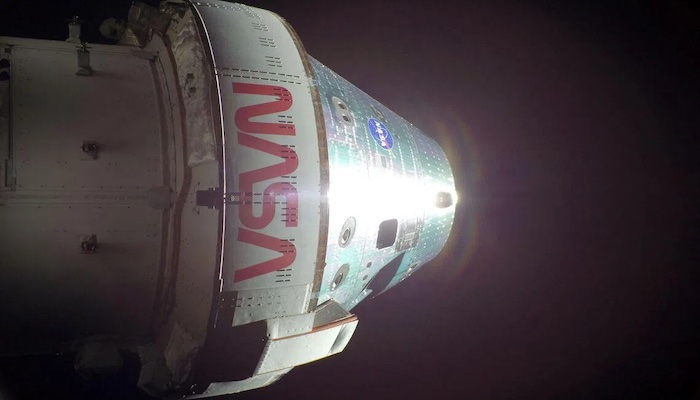
NASA astronauts Reid Wiseman and Christina Koch, along with Canadian Space Agency astronaut Jeremy Hansen, are part of a series of ambitious Artemis missions. These missions aim to re-establish human presence on the lunar surface by 2028 and lay the groundwork for future crewed expeditions to Mars.
Christina Koch described the Artemis program as a relay, stating, "In fact, we have batons that we bought to symbolize, physically, that. We plan to hand them to the next crew, and every single thing that we do is with them in mind."
Future missions, such as Artemis III, will involve crucial tests like docking Orion with lunar landers in Earth orbit. Artemis IV, planned for 2028, is set to mark the first crewed lunar landing since the Apollo 17 mission in 1972.
Meanwhile, lunar scientists at NASA's Mission Control in Houston closely monitored the astronauts' progress, analyzing real-time and recorded data from the Artemis II flight.
The crew's return is anticipated on Friday around 8 p.m. Eastern Time (0000 GMT Saturday), concluding a mission that lasted nearly ten days. Earlier on Monday, they set a new distance record, reaching approximately 252,000 miles from Earth, surpassing the previous record held by Apollo 13 by about 4,000 miles.
Reid Wiseman shared that each crew member had two brief video calls with their families during the mission. A particularly poignant moment occurred when Hansen suggested naming a newly identified lunar crater after Wiseman's late wife, Carroll, which resonated emotionally with both the crew and mission control.
During a six-hour pass over the moon, the astronauts observed the lunar surface from an altitude of about 4,000 miles, providing direct scientific observations. This enabled valuable real-time interactions between ground- based scientists and the crew in deep space.
Koch characterized the moon as a significant historical record, or "witness plate," of the solar system's development. She emphasized that Artemis II represents a vital initial step toward uncovering the secrets of our cosmic neighborhood.
Comments (0)
You must be logged in to comment.
Be the first to comment on this article!