
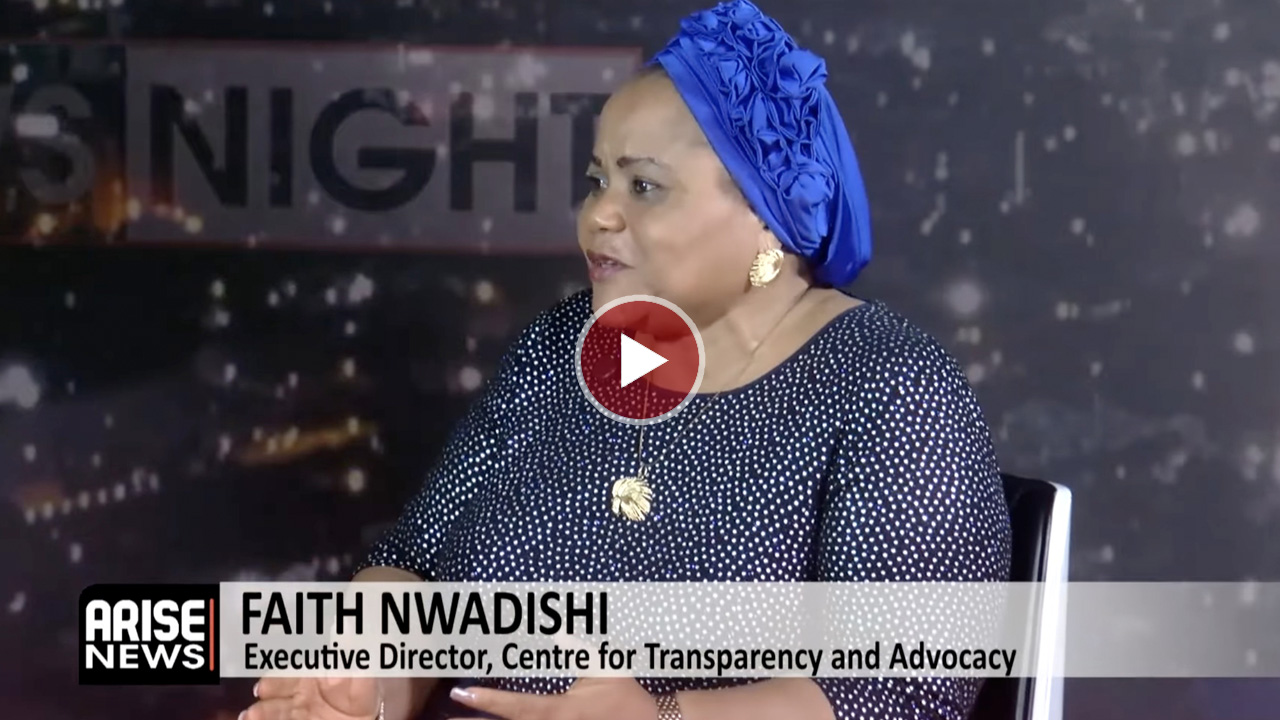
Faith Nwadishi, the Executive Director of the Centre for Transparency and Advocacy, has highlighted that Nigeria's prevailing voter apathy stems from the failure of the political class and insufficient civic education initiatives. She cautions that if left unaddressed, these challenges could significantly reduce electoral participation ahead of the 2027 elections.
In a recent interview with ARISE News, Nwadishi expressed that political parties and governmental organizations are falling short in informing citizens about their voting rights and responsibilities. "Voter apathy has been a persistent issue in our electoral processes. If I were to assign blame, I would point to two key stakeholders. The first is the political class, which does not sufficiently engage in voter education," she stated.
Nwadishi noted that political parties used to actively raise voter awareness during grassroots campaigning, a commitment that seems to have waned over time. "In my younger days, I would hear politicians talk about mosquito campaigns, and along with those campaigns, they provided voter education," she recalled.
"Back then, they would distribute sample ballots, demonstrating how to mark them correctly, all while making promises to the electorate. Nowadays, it seems politicians prefer to conduct voter education on social media, which is not where elections happen."
She further indicated that her organization’s preparations for the recent council elections in the Federal Capital Territory revealed significant gaps in engaging communities directly in voter education initiatives.
"I conducted outreach in various communities before the elections, and I found that many individuals insisted on financial incentives before they would even listen to information about voting. Politicians were notably absent in these educational efforts," Nwadishi remarked.
She criticized the National Orientation Agency for not fulfilling its mandate of delivering civic education nationwide. "The second entity I hold accountable for voter apathy is the National Orientation Agency. One of their key roles is to provide civic education to empower citizens for governance participation," she explained.
Despite the agency claiming to have representation in all 774 local government areas, Nwadishi pointed out that their presence is hardly felt in communities leading up to elections.
Nwadishi noted that while the Independent National Electoral Commission (INEC) has recently partnered with civil society groups for voter education, such activities typically commence too close to election dates. "To illustrate, during the last elections, INEC engaged with civil society for voter education, but the National Orientation Agency was nowhere to be found," she stated.
She added that despite claims of underfunding, a sound civic education infrastructure should not rely solely on last-minute efforts.
In addition to ineffective civic education, Nwadishi highlighted that widespread distrust of political representatives further deters voter engagement. "Politicians often fail to fulfill their promises. They may visit communities, make commitments, and then leave constituents waiting for results that never materialize," she said.
Reflecting on the excitement seen in 2015 during Nigeria's political transition, Nwadishi noted, "Back then, people had high hopes and anticipated change. Promises were made for the first hundred days, but disappointingly, none were actualized within that time frame."
She opined that such disappointments over the years have eroded public confidence in the electoral process.
Regardless of her criticism directed at political entities and institutions, Nwadishi emphasized that citizens must also acknowledge their role in participating in elections. "With rights come responsibilities. Citizens often bear the responsibility to engage actively," she stated.
Nwadishi underscored the importance of voter registration, highlighting that many Nigerians neglect to register or obtain voter cards despite being eligible. "Some individuals proudly claim they have never registered, even at the age of 56. That constitutes a failure to meet one's obligations as a citizen," she remarked.
She also stressed that civic engagement should begin at home, advising families to encourage their children to register as soon as they reach the voting age. "When someone turns 18, they need to exercise their right to be part of the electorate. The first step is to ensure they are registered," she emphasized.
Furthermore, she proposed incorporating civic education into the schooling system to foster early engagement in democratic processes. "Education should focus on ensuring that once a student reaches voting age, they are also registered. Parents should play a role in helping their children understand this civic responsibility," she concluded.
To tackle voter apathy effectively, Nwadishi called for a collaborative effort from political stakeholders, government agencies, civil societies, and the citizens themselves.
Comments (0)
You must be logged in to comment.
Be the first to comment on this article!