
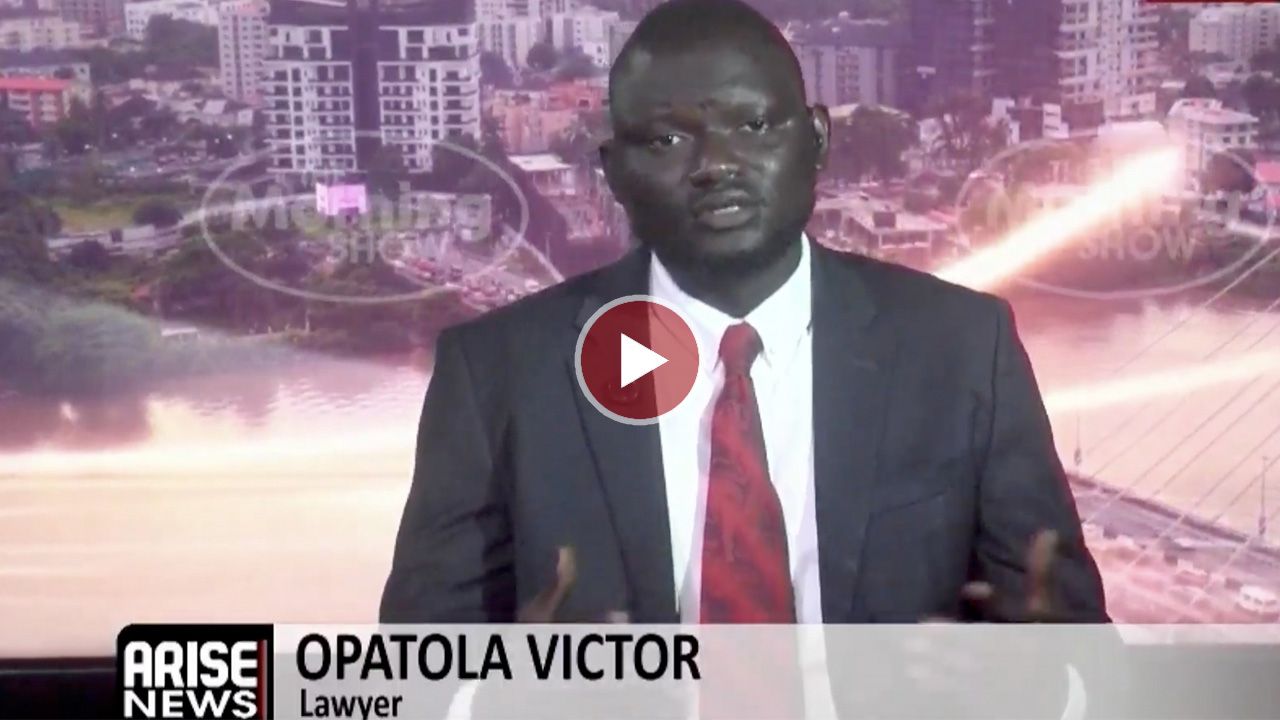
Legal practitioner Opatola Victor has cautioned that the actions of the Independent National Electoral Commission (INEC) risk diminishing the independence of political parties and jeopardizing the fairness of elections across Nigeria. This comes amid growing scrutiny of the electoral body's role in arbitrating internal disputes within political parties.
During an interview with ARISE NEWS on Thursday, Opatola specifically addressed recent controversies involving the African Democratic Congress (ADC) and INEC's engagement in party leadership disagreements. He expressed apprehension that the commission has strayed beyond its mandate as a regulator and has begun to assume the functions of the judiciary.
"In this particular instance, the mere fact that INEC chose to interpret, you know, what and decide what Thetosko is, it has ventured and stepped into the role of a judicial body, which is the court, which is wrong as an independent auditor," Opatola stated.
He further commented on the trend of political parties facing internal challenges, particularly when they pose a significant challenge to the ruling government. "When we look at the trajectory, the escalation and issues that arises from various political parties would stand as a major opponent to the current government. We tend to see that all of a sudden, they develop internal issues, which neutralises them as a major threat to the current APC, and that’s the current APC."
Opatola also addressed the issue of courts employing complex legal terminology, such as "Thetosko Antebellum," without sufficient explanation. He urged courts to provide clarity when issuing decisions. "When court gives its decision and use the word Thetosko, the court should endeavour to give clarity as to what it means by Thetosko Antebellum. From now, courts will decide these issues, will speak as to Thetosko Antebellum, should give clarity, should even go further than just drop this technical legal language. Should go further to give clarity and be exact as to what exactly is Thetosko Antebellum, and it will save the whole country, racking their heads to determine where the Thetosko Antebellum is or what exactly the Thetosko Antebellum is."
The legal expert criticized INEC for taking on a judicial function instead of directing the matter to the Court of Appeal. "What INEC ought to do was go back to the Court of Appeal for the court to determine what the Thetosko is, The ADC have a limited time to conduct their Congress. They have until 30th of May to conduct their primaries. So, going to Court of Appeal to get an interpretation, it would definitely take time."
Regarding leadership disputes within parties, Opatola pointed out the responsibility of party factions and the onus of proof. "Bala Gombe was the one that approached the court. He was saying that he did not resign and his signature was forged. That is to show that the burden of proof is on him, For that to be upturned, Bala Gombe ought to prove beyond reasonable doubt because he is approaching the court based on forgery and the fact that he did not resign."
Opatola expressed that public confidence in INEC has further eroded due to recent decisions and actions by its chairman, including the handling of the ADC issue and past electoral processes. "The recent issues, the recent decisions of INEC chairman, you know, the decision to revalidate people with permanent voter’s card, the present ADC decision, you know, it has even further reduced the level of trust that a number of Nigerians have in INEC, coming from the last election that a lot of people do not really have trust in INEC. So, these decisions have clearly reduced even more the rate at which people trust INEC to effectively give a free and fair, conduct a free and fair election."
Concerning public demonstrations against the INEC chairman, Opatola advocated for the use of established legal and legislative channels. "The protest should be directed at the National Assembly and also channelled via the court. Okay, directing this ventilation to the AINEC chairman, you know, giving our, it wouldn’t really work, you know."
He also analyzed the role of the judiciary in resolving intra-party conflicts, suggesting a need for clearer directives. "To be honest, the courts are not really, really helpful when it comes to this issue because what the Supreme Court ought to do is give a definite guideline, which will guide parties and individuals as to what exactly comes under internal party affairs, When you give this guideline, individuals can know that this claim that I have, does it fall within the set of guidelines that the Supreme Court has given or it does not? Then it reduces the incessant manner with which almost everybody in a party goes to court. Our courts will be barraged with continuous issues of internal party guidelines and simple and easy things that can be determined by a guideline that is already set, You know, the court will have to keep on adjudicating and adjudicating all over it, you know, and the docket of the court will keep being jam-packed. The precious judicious time will be wasted on some of these things."
Opatola concluded by reiterating that the ADC should seek judicial interpretation through the Court of Appeal, noting the time constraints involved. "The ADC have a limited time to conduct their Congress. They have until 30th of May to conduct their primaries. So, going to Court of Appeal to get an interpretation, it would definitely take time. So, the mere fact that INEC did what it did, it has placed a constraint on parties and it has ventured into a role it ought not to venture into."
Comments (0)
You must be logged in to comment.
Be the first to comment on this article!