
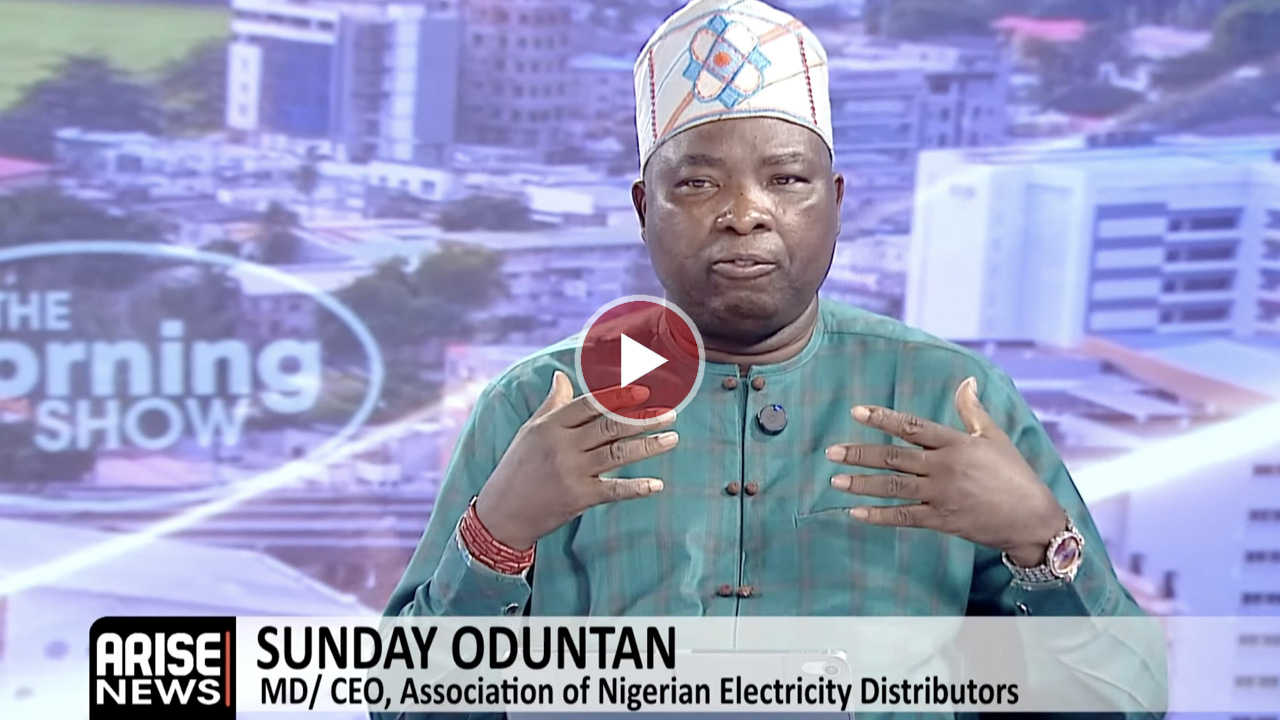
Sunday Oduntan, the Managing Director and Chief Executive Officer of the Association of Nigerian Electricity Distributors (ANED), has stated that the longstanding power crisis in Nigeria cannot be resolved within a single political term. He highlighted that addressing the country's electrical issues will require substantial time, investment, and continuous reforms.
In an interview with ARISE News on a recent Saturday, Oduntan expressed that it is impractical to believe that the electricity challenges built up over decades could be fixed in just four years.
"You cannot fix the adversity of 50 years in four years. Nobody can do that anywhere in the world," he asserted.
He outlined the profound structural and infrastructural deficits that have plagued the Nigerian power sector for years.
"Due to the extensive investment needed and the current state of infrastructure in the country, we need to concentrate on solutions—how to achieve progress step by step," Oduntan elaborated.
As the spokesperson for Nigeria's electricity distribution companies, he acknowledged that while some advancements have occurred since the sector was privatized, substantial challenges remain.
"I began working in this sector on November 1, 2013, so I can confidently say we are better off today than we were a decade ago. However, there's still much work ahead to improve further," he noted.
Oduntan stated that the demand for electricity in Nigeria significantly surpasses the current output.
"A nation that needs approximately 20,000 to 30,000 megawatts is only receiving between 4,000 and 5,000 megawatts. We've failed in this regard, and there's still a long road ahead," he added.
He pinpointed transmission infrastructure as a critical factor affecting electricity supply across the country, explaining that despite efforts by the Transmission Company of Nigeria to upgrade its systems, substantial barriers still hinder electricity delivery to consumers.
"Numerous bottlenecks exist. Over time, we’ve experienced stranded power because the supply cannot move from one location to another due to transmission constraints," he remarked.
Nevertheless, he conveyed optimism regarding the federal government’s initiative to create a Grid Asset Management Company (GAMCO), describing it as a potential breakthrough for the sector.
"The goal is to optimize power generation and modernize transmission evacuation processes, particularly as we have seen significant stranded power over the years," Oduntan commented.
He further explained that Nigeria's power system faces disparities between generation, transmission, and distribution capacities.
"If the country can generate 10,000 megawatts, it should also transmit and distribute that whole 10,000 megawatts. However, what we face in Nigeria is a mismatch," he said.
Oduntan also identified gas supply shortages as a major impediment to electricity generation.
"There are multiple issues, one being the shortage of gas," he explained, noting that many power plants are unable to operate at maximum capacity due to insufficient fuel.
He clarified that Nigeria possesses a higher installed generation capacity than what is currently being produced.
"The generation capacity has often reached 11,000 to 14,000 megawatts, but we are not able to utilize it to its full potential," he pointed out.
Additionally, he addressed the recent directive from the Nigerian Electricity Regulatory Commission (NERC), which ordered electricity distribution companies to reimburse ₦20.33 billion to customers who had purchased meters through the Meter Asset Provider scheme.
He assured that distribution companies would adhere to this directive and ensure affected customers receive their refunds.
"The mandate from NERC is positive. As service providers, we must guarantee that the system is trustworthy and comply with the regulations imposed by our regulator," he affirmed.
Oduntan assured that customers awaiting refunds would eventually receive their payments, including any outstanding amounts.
"When full implementation commences, those who have yet to receive credits will get their payments in arrears because this must be paid, and it will be paid," he confirmed.
He mentioned that certain distribution companies have made considerable strides in refunding customers.
"For instance, NERC has reported that Ibadan Disco has completed refunds of up to 92 percent under the MAP scheme," he said.
Oduntan urged politicians, critics, and stakeholders to refrain from politicizing electricity issues and focus instead on sustainable, long-term solutions.
"The government, citizens, the opposition, and critics need to help us depoliticize the Nigerian power sector. We cannot afford to continue this politicization," he insisted.
Despite the ongoing difficulties, he expressed a firm belief that Nigeria will eventually conquer its electricity challenges.
"I am very confident that there will be power in Nigeria. I am absolutely sure that Nigeria will have electricity. It's just a matter of time," Oduntan concluded.
Comments (0)
You must be logged in to comment.
Be the first to comment on this article!