
Reno Omokri, an ambassador designate, has criticized David Mark, the former Senate President, for endorsing the call for real-time transmission of election results.
Mark, who is currently the chairman of the African Democratic Congress (ADC), joined fellow opposition leaders on February 26 at a press briefing in Abuja. They collectively urged for the repeal of the new electoral law, which permits real-time result transmission while also allowing for manual counting in case of transmission failures.
The briefing saw notable figures such as Atiku Abubakar, Peter Obi, and Rotimi Amaechi, all expressing their discontent with the adjustments made to the electoral framework.
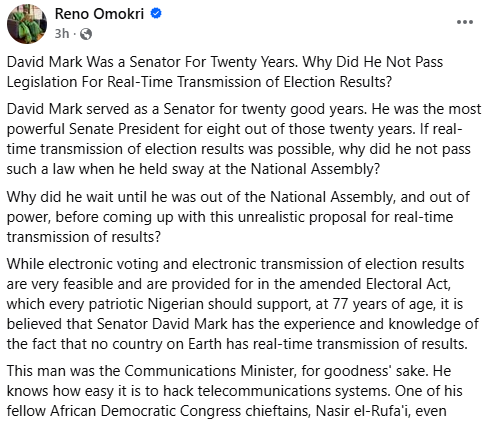
In his response, shared via a Facebook post, Omokri questioned Mark's commitment to real-time transmission during his tenure as Senate President. He emphasized that no nation currently implements real-time result transmission. He wrote:
"David Mark was a Senator for twenty years. Why did he not pass legislation for real-time transmission of election results? Having served as Senate President for eight years, if real-time transmission was feasible, why didn’t he legislate for it while he was in the National Assembly?

Why did he wait until he was no longer in power to advocate for this apparently unrealistic idea?
Even at 77 years old, Senator Mark should recognize that no country in the world manages real-time result transmission.
Given his background as former Communications Minister, he understands how easy it is for telecommunications systems to be compromised. His party colleague, Nasir el-Rufai, has even admitted to knowing an individual who hacked the phone of the National Security Adviser.
If opposition members can breach communications of the highest security official, what’s stopping other malicious entities from hacking the Independent National Electoral Commission's systems to manipulate results?
It was actually Mark's predecessor in the role of Communications Minister who stated, 'Telephones are not for the poor.' Now, in a nation rife with telecommunications gaps, Mark and others demand real-time results?
Name one country that accomplishes this. Opposition members often mention Brazil and Estonia, but that is misleading.
Neither Brazil nor Estonia practice real-time result transmission. Their results are transmitted electronically only after polling ends, which aligns with what is being proposed for Nigeria.
In those nations, votes are not sent live to the central collation center; the transmission occurs post-election closure.
Moreover, even in Brazil, for example, the law encompasses provisions for manual tabulation if electronic methods encounter issues, as it is commonsensical to predict areas lacking internet or power access in such a large nation.
The United States, which is home to Starlink, similarly does not implement real-time result transmission. The same goes for the United Kingdom, France, and Germany.
Amazon Web Services, a leading cloud service provider, has sustained significant cyberattacks leading to major security breaches and outages. Mark, a military veteran, ought to be aware of the numerous cyber incidents faced by both the U.S. military and Russia, even with their advanced systems.
Given this context, how can Mr. Mark claim that the Independent National Electoral Commission should ensure an infallible system, which even the most powerful military forces cannot promise?
As long as every political party has agents at each polling unit and the relevant forms are signed, electoral manipulation should be impossible. The real issue lies in the organizational shortcomings of some parties to appoint agents at polling units, and instead of addressing this deficiency, they seek unrealistic changes to the Electoral Act."
Comments (0)
You must be logged in to comment.
Be the first to comment on this article!