
Governor Siminalayi Fubara of Rivers State has articulated that his intentional display of 'weakness' amidst political challenges is meant to safeguard the peace and stability of the state.
Fubara expressed these sentiments while receiving the 2025 Man of the Year Award from the New Telegraph.
In his address that focused on leadership burdens, the impacts of political strife, and the necessity for reconciliation, he dedicated the accolade to his predecessor, Nyesom Wike, who now holds the position of minister for the Federal Capital Territory (FCT).
"I do not care how you interpret it or misinterpret it. I also dedicate this award to somebody who discovered me, not minding the situation — the honourable minister of FCT, Nyesom Wike," Fubara remarked.
The governor emphasized that the trials faced by him and his supporters have often been perceived in diverse ways, but he maintains that his response is purposeful.
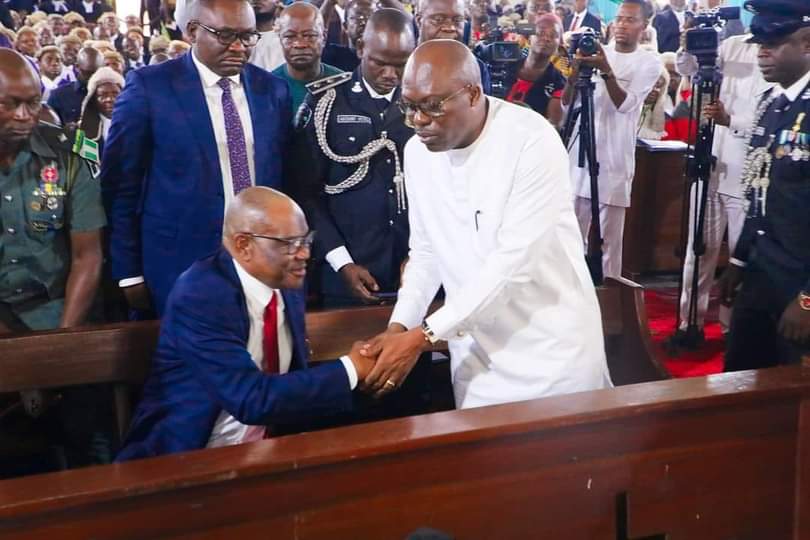
"Some people have labeled these struggles as weakness, while others argue it reflects strength. However, I consciously choose to be weak for several reasons — weak because I desire peace, weak for our survival," he noted.
Fubara further elaborated, "Weak because I need to safeguard what is precious, not only to me but also to our beloved nation. Weakness can be a strength; it is beneficial at the right moment."
He extended his gratitude towards his family and the citizens of Rivers State for their patience and maturity during the ongoing political turmoil.
Recently, President Bola Tinubu stepped in to mediate tensions between Fubara and the Rivers State House of Assembly after prolonged discord that included impeachment threats and legislative division.
Most assembly members are viewed as loyal to Wike, who has been vocal against Fubara’s bid for re-election, accusing him of violating a peace pact allegedly made before Tinubu lifted the emergency rule that had been imposed on the state.
An analysis by Monima Damanibo in his latest Daily Trust column highlighted these unfolding events in Rivers State. Damanibo raised questions in his piece titled: 'Fubara: Where is 'people power' in your strategy?' and noted that some have been addressed by the governor.
"Once more, the governor of Rivers State, Siminalayi Fubara, has dissolved the state’s Executive Council. This action appears to be a conciliatory gesture towards some discontented members of the Rivers State House of Assembly who are aligned with his predecessor, Nyesom Wike," he wrote.
Damanibo continued, "It is worth recalling that this situation was previously identified as a condition put forth by Wike's camp during a peace dialogue mediated by President Bola Tinubu between Fubara and Wike. This decision signifies yet another concession by Fubara to Wike, with ramifications exceeding personal stakes. Even at its fundamental level, dissolving a state executive council implies a significant restructuring of governance; it is not a decision taken lightly."
He explained that in traditional Ijaw leadership, certain rituals signify the expectations held by the community towards a leader. These rituals often involve a choice between symbols of warfare and provision for the people. Consequently, in a statutory context, all these responsibilities are encapsulated in the constitutional oath.
As Rivers State's first democratically elected governor of Ijaw heritage since the tenure of Melford Okilo and Rufus Ada George, Fubara is often viewed through the lens of fulfilling the obligations associated with this status.
The ongoing power struggle between Fubara and Wike has kept the public on alert, trying to anticipate each leader's next strategic move. Thus far, Wike has aggressively worked to undermine the sitting governor, threatening his prospects for a second term in 2027.
Meanwhile, Fubara has demonstrated resilience through strategic actions and a composed demeanor, often capitalizing on Wike's missteps. Recent interventions by President Tinubu, marking the third instance, aim to encourage peace and allow Rivers State to experience a much-needed respite from continual governance instability.
Comments (0)
You must be logged in to comment.
Be the first to comment on this article!