
Skild AI Inc., a rapidly advancing startup specializing in robotics software, has successfully secured around $1.4 billion in its Series C funding round, bringing its valuation to over $14 billion. This new figure represents a remarkable increase of more than three times its value just seven months earlier, reflecting an increasing investor interest in the field of robotics driven by artificial intelligence.
The funding round was spearheaded by SoftBank Group Corp., with contributions from Nvidia Corp., Macquarie Group Ltd., 1789 Capital, and Jeff Bezos’ investment firm, Bezos Expeditions, as noted by co-founder and CEO Deepak Pathak. Other stakeholders include existing investors like Lightspeed Venture Partners, Felicis Ventures, Sequoia Capital, and Coatue Management, along with newcomers such as Samsung Electronics, LG Electronics, and Salesforce.
Located in Pittsburgh, Skild has raised nearly $2 billion since its inception in 2023, with its valuation sitting at about $4.5 billion as of mid-2024.
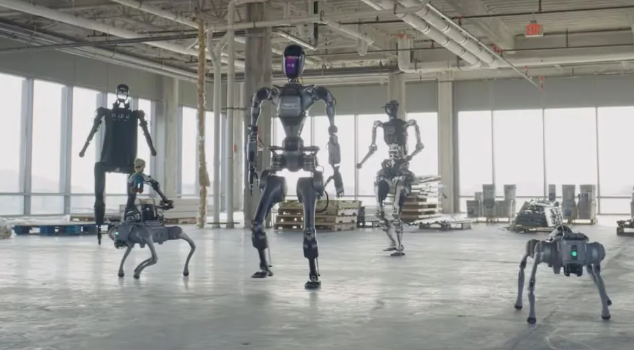
Skild is part of a new generation of robotics startups that are attracting significant funding by focusing on general-purpose intelligence rather than just task-specific automation. Their key product, the Skild Brain, is envisioned as a universal AI system capable of adapting across various robots, settings, and tasks through learning derived from observation and practice, resembling human learning processes.
Pathak asserts, “There is no ‘Internet of Robots’; real-world data is essential for constructing a general robotic brain, which has been our primary objective from the outset.”
The Skild Brain operates on conventional GPUs without the necessity for specialized hardware, utilizing extensive libraries of human-generated videos and simulation datasets for training. As robots function in real-world scenarios, their activities and mistakes produce feedback that continuously enhances their performance. This system merges internal factors such as force and joint movements with external inputs like visual data to facilitate situational awareness and robustness.
In the words of president and co-founder Abhinav Gupta, the technology enables robots to adjust even amid component failures, thus boosting safety and reliability. He explains, “If an arm fails, the robot can still carry out the task.”
The startup intends to leverage the new funding to broaden the deployment of its software, improve training mechanisms, and introduce robots in additional environments. Their software is compatible with various machines, including quadrupeds, robotic arms, and humanoids, applicable in settings like hospitals, warehouses, households, airports, and construction sites.
Skild also reports a swift growth trajectory, moving from no revenue to tens of millions within just months in 2025, and is currently collaborating with over eight clients. One significant partnership involves a Skild-powered service robot at New York’s LaGuardia Airport, employed for air quality monitoring, while LG CNS is working alongside the company on humanoid robotics developments.
The substantial valuation of Skild mirrors a broader trend in which major tech firms are opting for strategic investments to access emerging AI capabilities rather than resorting to large-scale acquisitions. Companies like Nvidia and Samsung are investing in several robotics startups while the industry shifts towards general-purpose machines.
With a workforce exceeding 100, comprising talents from companies like Meta, Tesla, Nvidia, Amazon, and Google, Skild is at the forefront of what industry analysts refer to as robotics’ ‘GPT moment,’ where machines evolve from functioning solely as specialized tools to becoming versatile, smart systems.
The founders hold the belief that advanced robotics could ultimately replace over a million hazardous or undesirable jobs in the United States, enhancing human labor rather than displacing it. “This transformation won’t occur overnight,” Pathak states. “We have ample time to prepare, and the long-term consequences can prove beneficial.”
Comments (0)
You must be logged in to comment.
Be the first to comment on this article!