
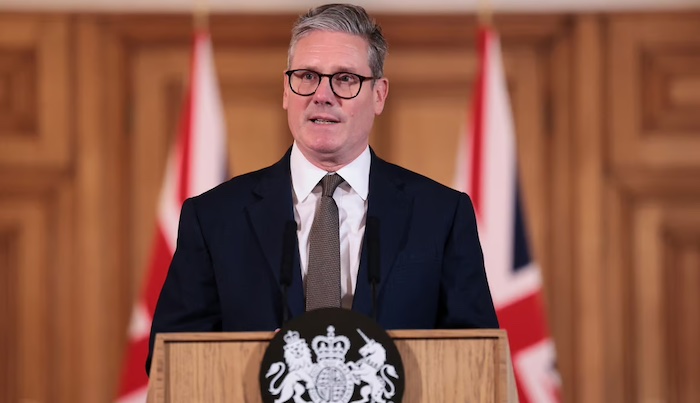
Prime Minister Sir Keir Starmer is reportedly contemplating an expedited and considerable increase in the UK's defence expenditure, possibly allocating billions more than initially planned, according to BBC reports.
Discussions are underway at Downing Street regarding proposals to achieve the existing goal of dedicating 3% of the nation's gross domestic product (GDP) to core defence by the conclusion of the current parliamentary term, which could extend to 2029. This acceleration would bring forward by several years an objective that was originally slated for the subsequent parliament.
Last year, Sir Keir committed to raising defence spending to 2.5% of GDP by April 2027, with a further ambition to reach 3% in the longer term. He recently indicated a heightened sense of urgency at the Munich Security Conference, telling global leaders, "To meet the wider threat, it’s clear that we are going to have to spend more, faster."
This consideration arises from escalating concerns over defence costs and intensifying global security challenges, particularly those posed by Russia. Reports suggest that the Ministry of Defence (MOD) requires an additional £28 billion over the next four years to fulfil its current obligations. Earlier this year, Chief of the Defence Staff Sir Richard Knighton informed MPs that the current budgetary allocations were insufficient to deliver all necessary capabilities at the desired pace.
The Office for Budget Responsibility estimates that increasing defence spending to 3% of GDP by the 2029-30 fiscal year would necessitate an annual increase of over £17.3 billion. The Institute for Fiscal Studies projects a slightly lower figure, between £13 billion and £14 billion, after accounting for planned enhancements. In the preceding year, the UK's defence expenditure was approximately £66 billion, equating to roughly 2.3% of its GDP.
While no definitive decision has been made, and Treasury officials are reportedly expressing caution regarding the financial ramifications, the move is being considered. Some within the government argue that advancing this target would underscore the UK's commitment to its NATO responsibilities, which include a long-term aim of reaching 3.5% of GDP for core defence by 2035. Conversely, others highlight the potential strain on public finances.
Potential avenues for funding the increase are said to be under review, such as reallocating funds from overseas development aid, net-zero initiatives, or significant infrastructure projects like the high-speed rail line connecting London and Birmingham. Increased borrowing is also being considered, though Treasury officials are keen to avoid contravening fiscal rules and causing market instability.
Defence sector sources indicate that meeting the 3% target sooner would be favourably received by the United States and would bolster the UK's leadership role within NATO. In Munich, Sir Keir characterised increased defence investment as a crucial strategic imperative, stating, "We must build our hard power because that is the currency of our age. We must spend more, deliver more, and coordinate more."
Foreign Secretary Yvette Cooper supported this perspective, describing the government's strategy as the most significant sustained rise in defence spending since the Cold War. She commented, "We are going to need to go further, of course we will need to go further, because we are going to need to strengthen our defence and our partnerships in order to be able to do so."
An MOD spokesperson declined to comment on the ongoing speculation, stating, "We do not comment on speculation. The government is focused on delivering for defence. We are delivering the largest sustained increase in defence spending since the Cold War, with an extra £5bn for defence this financial year alone."
The current discussion revolves around the UK's capacity to accelerate this spending increase and the methods for financing it, especially as global geopolitical tensions escalate.
Melissa Enoch
Comments (0)
You must be logged in to comment.
Be the first to comment on this article!