
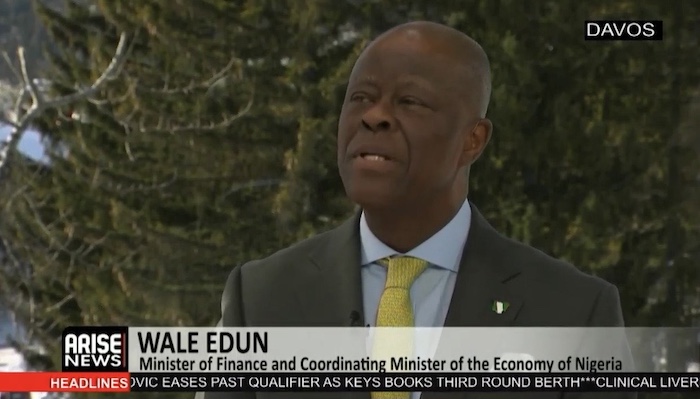
Finance Minister Wale Edun has articulated that the country's reforms, partnerships, and infrastructure initiatives are designed to lure investors to Nigeria while generating job opportunities.
In a conversation with ARISE News this Thursday at Davos, Edun stressed Nigeria’s enhanced efforts to establish itself as a prime hub for foreign direct investment, pointing out recent global economic strategies and reforms aimed at fostering a stable investment environment.
"We are targeting investments that will boost productivity and facilitate economic growth. Consider that the United States recently unveiled a substantial $1.4 trillion investment package over a projected 20-year span, and we aim for similar developments here as well," stated Dr. Edun.
"Our mission here is to assert Nigeria's attractiveness for foreign investments. Notably, Mr. President's global economic engagements led to the recently signed comprehensive economic partnership agreement with the UAE. Such steps are critical to appealing to investors seeking profitable, predictable, and sustainable investment environments.
Dr. Edun also highlighted the need for returns on investments, mentioning ongoing discussions aimed at revealing several investment opportunities akin to those presented by others at this conference. "We are here not just to attract foreign investments but also to communicate our case to Nigerians both abroad and within the country," he added.
Additionally, Dr. Edun addressed how geopolitical shifts, such as former U.S. President Donald Trump's statements and prevailing global economic conditions, may influence Nigeria's ability to engage with potential investors.
"Certainly. It’s notable that for the third successive year, the U.S. President has voiced at Davos about America’s status and his assurances regarding its ongoing robust performance. His audience was largely European, and his message particularly targeted them following his declaration against military interventions and tweaks to the import tariff policies from last April," Dr. Edun remarked.
"For us, what is crucial is our commitment to an open economy and our efforts toward free market practices, while we observe a trend of increasing global trade and output. Currently, Africa's contribution to world trade stands at roughly 3% and 2.5% of global production, and as these numbers rise, our export capabilities will expand. Although we export just under $4 billion to the U.S., it’s critical that these numbers trend upwards, particularly in a climate influenced by policies that do not constrain global trade. Trump’s comments, in fact, were reassuring for us," he explained.
Dr. Edun reiterated that the government’s ongoing reforms aim to uplift Nigerians domestically, emphasizing job creation, increased income, and better access to technology and infrastructure.
"The policies we pursue are designed to engender rapid, sustainable, and inclusive growth that translates into employment opportunities and enhanced earnings for Nigerians," he noted, underscoring a focus on revitalizing the manufacturing sector through initiatives such as those from Dangote and other private refineries, which promote domestic production for both local consumption and exports.
Dr. Edun emphasized the importance of Africa’s demographic advantage, predicting that by 2050, 25% of the global workforce will be located in Africa, stressing the need for skills and opportunities to integrate them effectively into the global economic framework.
He also brought attention to efforts aimed at empowering the youth in Nigeria and bolstering the technology and services sectors.
"We are engaging with major global technology firms to further investments in Nigeria, cultivating our talent, and extending infrastructure like the anticipated 90,000-kilometre fibre optic network. This upgrade will enable our youth to market their services internationally via the internet. Enhancing the profitability of services exported by young people is crucial, as is our discussion around modernizing library access through automation.
Furthermore, we're emphasizing collaborations that increase access to finance, skills, and market opportunities as part of our first development program, aimed at amplifying productivity among economic players," he concluded.
Dr. Edun reinforced the Nigerian government’s pledge to ensuring macroeconomic stability while boosting private sector engagement in governmental initiatives and investments.
"The response to inquiries about government asset sales is that it should lead to private sector funding and involvement in government affairs. The government shall facilitate an environment conducive to private sector engagement by creating stability and predictability in macroeconomic conditions," he explained.
He added, "We aim for high net returns and witnessed robust capacity across market offerings last year. Stability in the market is crucial, which includes maintaining a constant exchange rate – a significant shift from previous practices where currency conversions were predominantly driven by opportunistic bets. We must ensure investment openings present opportunities for retail and substantial investors alike, including foreign parties willing to establish manufacturing plants.
Ultimately, Dr. Edun stated, Nigeria's long-term goal remains focused on doubling economic output relative to population growth to elevate millions out of poverty.
"We have a mere 20 minutes left in our session. We project a growth rate of 4.6 to 8%, with aspirations for even higher, aiming for 7% annual growth to match population growth. This is the tipping point where we believe the wealth of Nigerians can significantly improve, lifting millions out of poverty – which is the overarching goal of these policies.
Boluwatife Enome
Comments (0)
You must be logged in to comment.
Be the first to comment on this article!