
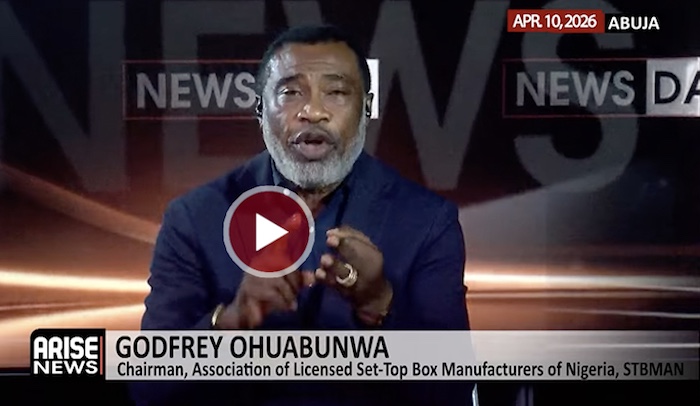
Godfrey Ohabunwa, who also chairs the Association of Licensed Set-top Box Manufacturers of Nigeria, has pinpointed the National Broadcasting Commission (NBC) as the primary cause for the prolonged delay in Nigeria's digital switchover, citing a decade and a half of policy inconsistencies and regulatory deviations.
In a recent interview with ARISE News on Friday, Ohabunwa stated that the Nigerian Digital Switchover White Paper, which received Federal Government endorsement in 2015 following extensive committee deliberations, provided a clear implementation blueprint. However, he asserted that the NBC has consistently failed to follow this established plan.
"The delay is because of One: Inconsistency in policy. Two: People who manage the DSO program probably do not or have not read the document. Three: Some selfish ambition," Ohabunwa remarked.
He further explained that while the Federal Government met its obligations by approving the policy, licensing entities, and making substantial investments in infrastructure, the NBC, in its role as the sector's regulator and custodian of the digital switchover, has repeatedly undermined the programme's progress.
Ohabunwa elaborated that the DSO policy's objective was to transition Nigeria from analogue to digital terrestrial broadcasting, aligning with International Telecommunication Union standards. This shift is crucial for freeing up spectrum essential for broadband expansion and enhancing the overall efficiency of broadcast services.
He recalled that the programme saw tangible advancements between 2016 and 2018, with digital broadcasting successfully launched in eight states. During this period, transmission companies were deploying necessary infrastructure across the country, and manufacturers were investing millions into the production of decoders.
However, Ohabunwa noted that the momentum stalled significantly as the NBC reportedly refused to deactivate analogue transmissions. This decision, he argued, has made the complete implementation of the Digital Switchover programme unachievable, despite the considerable financial investments already made.
"But since then to today, NBC has refused to switch off the analog. Thereby making it difficult for the full implementation of the DSO," he declared.
Furthermore, Ohabunwa voiced his disapproval of the NBC's reported inclination to shift focus from Digital Terrestrial Television (DTT) to Direct-to-Home (DTH) satellite broadcasting. He argued that this proposed change directly contradicts the original government-sanctioned framework.
He pointed out that DTH technology is not a novel concept in Nigeria, referencing the established presence of satellite television providers such as MultiChoice, GOtv, and StarTimes. Therefore, he questioned the necessity and impact of the NBC's proposed new direction, deeming it both unnecessary and disruptive.
"What NBC is doing negates the Federal Government policy," he stated emphatically.
Ohabunwa cautioned that abandoning the DTT path would render over 250,000 manufactured set-top boxes, valued at more than $10 million, obsolete. This move would also jeopardize substantial loans, infrastructure investments, and government expenditure estimated to exceed ₦60 billion.
In conclusion, Ohabunwa implored the Federal Government to mandate the NBC to revert to the approved White Paper and diligently implement the original digital switchover roadmap. He stressed the fundamental principle that regulatory bodies should not supersede established national policies.
Comments (0)
You must be logged in to comment.
Be the first to comment on this article!