
In a representative democracy, the main duty of the parliament is to advocate for the interests of the citizens and ensure their voices are acknowledged. Even in times of crisis, it is crucial for the parliament to maintain its voice. If it fails to do so, the repercussions can be severe, harming the populace and jeopardizing democracy itself. This highlights the importance of the legislature, which scholars like Professor Ben Nwabueze have argued is the most vital component of government within a democratic framework. Hence, when anti-democratic forces seek to undermine democracy, the first institution they target is typically the legislature, while other branches such as the executive and judiciary may operate under various forms of governance.
A critical function that underscores the importance of parliament is its oversight role, whether in peaceful or tumultuous times. It is responsible for ensuring that the executive branch does not overstep its authority and that citizens' rights are safeguarded. Should a parliament neglect this duty, it results in a power vacuum that can be exploited by those in positions of authority.
Recently, numerous commentators and observers in the media have expressed concerns regarding the legislature at both the federal and state levels. There have been insinuations, fueled by comments from prominent leaders within the national assembly, suggesting that the federal legislature has diminished its power in favor of the executive. Observers have noted a troubling amalgamation of powers rather than a clear-cut separation. For example, in the current 10th Assembly, nearly every proposal presented by the president passes through the bicameral legislature without adequate examination. Furthermore, almost all presidential nominees, whether for ministerial or ambassadorial roles, have been swiftly ratified by the Senate without substantial inquiry. The recently established National Assembly Library being named after the executive's head, the President, also raised eyebrows.
As we approach two and a half years into the 10th Assembly, there has not been a significant challenge to executive bills or requests for foreign loans. Consequently, there is growing concern among the populace about a Nigerian parliament that appears to have muted its voice. This observation is not new; the previous 9th Assembly faced similar criticisms, leading one commentator to describe it as “user-friendly” to the executive branch.
Critics are vocalizing that without an effective level of parliamentary oversight, the executive branch may act unchecked, resulting in corruption and misuse of power which the nation is currently experiencing.
While Nigeria has enjoyed 26 continuous years of democracy, there are indications of an erosion of public trust. In the absence of trust, citizens may grow disillusioned with their government and democratic institutions, leading to widespread dissatisfaction. This has become a common topic in discussions about democracy in Nigeria, the continent's most populous nation and a beacon for the African race.
Additionally, the public is raising alarms over human rights violations. The lack of rigorous parliamentary oversight is seen as a factor leading to government actions that infringe on human rights, as there are no proper checks in place.
Indeed, an effective parliament is crucial for the success of democracy anywhere in the world. When it loses its voice, it is the people who bear the brunt of the consequences. Observers who have highlighted significant trends of absenteeism in Nigeria’s federal legislative process argue that it is vital to enhance parliamentary oversight, boost transparency, and empower the opposition to assure that citizens’ interests are adequately represented and defended.
A recent publication by an insider, Senator Effiong Bob, challenges prevalent notions surrounding Nigeria's legislators. The book, titled ‘The Burden of Legislators in Nigeria’, spans 508 pages and combines institutional analysis, symposium discussions, and political context to reveal the numerous challenges that face representatives at both the federal and state levels in Nigeria. According to Bob, the undertaking is more demanding than many outsiders may recognize. His work offers an exploration into the intricate institutional, political, and human dynamics involved in legislative responsibilities during the Fourth Republic.
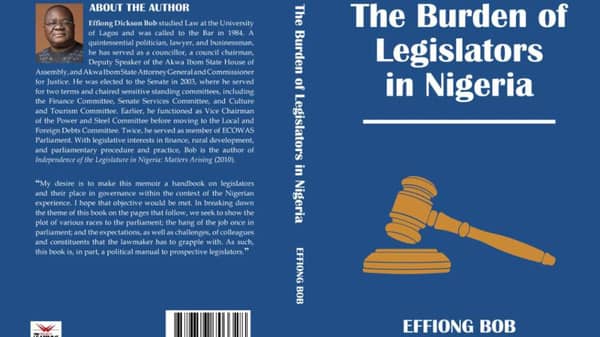
As if proactively addressing critical commentary on insufficient representation, Senator Bob’s book deconstructs the intricacies of representative democracy and governance from the perspective of someone who has participated in the process.
The publication includes insights from key figures within the Senate and the House of Representatives during the Fourth Republic, although notably absent is the voice of former Senate President Bukola Saraki.
Despite this omission, the book presents a diverse array of perspectives on the Nigerian legislative experience. It serves as a guide for those considering entering the complex world of politics, where they will encounter challenges like nomination hurdles, party politics, and the formidable issue of god-fatherism, which remains a pivotal factor for both success and failure. Moreover, the author, a legal practitioner, stresses the unavoidable pressure from constituents.
Bob’s publication details the arduous journey from gaining party nomination to the individual challenge of obtaining and retaining a mandate. He underscores the importance of upholding democratic values over military control at all times. Through his experiences, Bob ignites a conversation about the need for a comprehensive reform agenda to restore the legislature's independence within Nigeria’s governance framework, as many believe it has not been yielding tangible benefits of democracy.
The ten chapters of the book commence with a classic definition of the legislature and its functions before delving deeper into constraints lawmakers must navigate while serving their constituents. Readers can find valuable insights from former and current leaders of the Senate, such as Anyim Pius Anyim, Ken Nnamani, David Mark, Ahmad Lawan, and Godswill Akpabio, whose perspectives illuminate some complex dynamics within legislative practice.
In Nigeria, legislators encounter a distinctive challenge of reconciling their roles as lawmakers with the populace's expectations for immediate tangible benefits. This misalignment between law-making and providing concrete gains has imposed a significant load on elected officials, often hindering effective governance.
The expectation gap leads many Nigerians to regard their elected officials as service providers, anticipating them to deliver infrastructure and employment opportunities. This mindset, which has persisted from years of military governance focused on tangible deliverables, pressures legislators to prioritize visible projects over genuine policy formulation. Thus, the challenges intrinsic in law-making in Nigeria arise.
Legislation is typically a complex, often unacknowledged task. The process of drafting laws involves extensive research, consultation, and compromises that frequently go unnoticed, as it is the tangible outcomes that attract votes. Consequently, there is a tendency to focus on short-term accomplishments rather than establishing enduring policy frameworks.
Nigerian legislators grapple with the dichotomy of catering to their constituents’ immediate needs while fulfilling their responsibilities as law- makers, resulting in:
Project-focused politics: Legislators tend to favor visible initiatives to showcase their effectiveness.
Pork-barrel politics: Funds are distributed based on political expediency rather than national interest.
Lack of policy emphasis: Key national matters receive insufficient attention.
The dynamics of this political landscape have led to several repercussions across the nation:
Ineffective governance: Subpar policy-making impedes economic advancement and progress.
Corruption: Emphasis on projects fosters opportunities for corrupt practices.
Disillusionment: Public discontent with politics breeds apathy and skepticism.
In addressing these problems, Bob’s book revisits the constitutional roles and duties of the Nigerian legislature, encouraging citizens to perceive this institution as vital to democracy and governance. The functions of the legislature, ranging from legislative action and representation to oversight and financial control, underscore its critical importance in a functional democratic system.
While ‘The Burden of Legislators in Nigeria’ may not present a striking title, its implications and depth are significant. The work incorporates viewpoints from both national and state assembly members. Furthermore, it extensively uncovers the democratic obstacles entrenched in Nigeria's complicated internal political dynamics, including nomination disputes, god-fatherism, and barrier- filled pre-election scenarios. Bob argues that these challenges significantly undermine democratic processes before legislators are even sworn in.
He calls for a greater understanding among those unacquainted with the inner workings of the political system about how ‘political overlords’ often manipulate candidate selections and impose undue influence upon legislators once they take office. The book reveals the extent to which powerful politicians have been subordinating elected officials to personal interests rather than those of their voters, illustrating the burden carried by Nigeria's legislators, which is often overlooked by the public and media.
Readers will find valuable insights concerning the heavier burdens legislators bear through reflections by Senator Bassey Ewa-Henshaw and remarks from Senator Ikechukwu Godson Abana included in the text. Bob chronicles the internal pressures and complexities that regularly inhibit political stability and public service continuity. He posits that pursuing a political career is not suited for the faint-hearted.
Is serving in the national or state assemblies merely a shortcut to wealth, as perceived by constituents? The author refutes this notion, stating that it is but a myth, illustrated through stories of legislators who exited their posts in worse financial conditions, hampered by continuous demands from constituents whose expectations are often unrealistic.
The foreword of the book is penned by Professor Philip Afaha, a former Deputy Vice Chancellor of the University of Abuja. He emphasizes that the book should be understood within Nigeria's quest for reform of institutional frameworks that should nurture democracy to yield public goods. Afaha, a history professor and Parliamentary democracy expert, asserts that the book serves as a critical tool for reforming perspectives on democracy and good governance. Additionally, it elaborates that despite its recognized flaws, democracy presents a more viable environment for representative governance than authoritarian alternatives.
According to the publisher, Premium Times Book, 'The Burden of Legislators in Nigeria' makes a seminal addition to Nigeria’s democratic literature, intertwining historical narratives, lived experiences, and actionable recommendations to enhance the understanding of legislative politics while suggesting pathways towards strengthening democratic governance.
Senator Effiong Dickson Bob is a lawyer with significant experience serving Akwa Ibom State as both a federal and state legislator, as well as a commissioner. He has held various key positions, including Deputy Speaker of the Akwa Ibom State House of Assembly, Local Government Chairman, Attorney General, and Commissioner for Justice in the state. He has also served as a two-time Senator representing the Akwa Ibom North-East Senatorial District. While in the Senate, Bob chaired several standing committees, including those on Finance and Culture and Tourism. Furthermore, he represented Nigeria at the ECOWAS Parliament on two occasions. Bob is also credited with authoring 'Independence of the Legislature in Nigeria: Matters Arising' in 2010.
This new publication serves as a call to action for other notable state actors to contribute writings that can enhance democracy, which appears to be on a decline.
Comments (0)
You must be logged in to comment.
Be the first to comment on this article!