
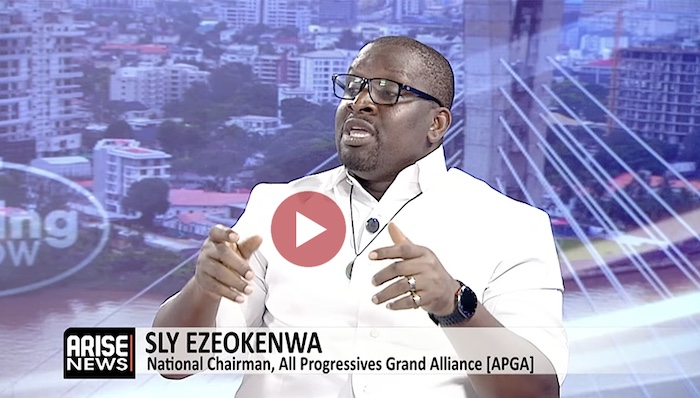
The National Chairman of the All Progressives Grand Alliance (APGA), Ambassador Sly Ezeokenwa, has expressed serious concerns regarding specific sections of the 2022 Electoral Act, especially Section 77, stating that it poses a threat to the independence of political parties and could hinder internal democracy.
In an interview with ARISE News on Thursday, Ezeokenwa noted that although some elements of the Act are advantageous, others create hurdles for political parties and their members.
"Many Nigerians have been advocating for an amendment or substantial revision of the Electoral Act to fulfill the demands for transparent and credible elections. It is crucial to establish a framework where citizens' votes truly have an impact," he remarked.
He acknowledged that APGA endorses several provisions of the Act, including the implementation of direct primaries and the digitized registration of party members, which are innovations that the party itself has supported.
“When our current National Working Committee of APGA took office under the guidance of our national figure, Professor Charles Chukwu Masoludu, we championed the introduction of direct primaries, which has ignited conversations in this political climate.
"Some individuals argue against direct primaries, insisting on maintaining the old methods that offered options such as direct, indirect, or consensus selection. However, we believe that the indirect selection process proves to be excessively costly," he elaborated.
Ezeokenwa also highlighted that APGA had already established a digital registration platform for members on June 1, 2024, ahead of its enforcement by the Act.
Nonetheless, he criticized the Act for imposing restrictions on how parties can manage their member registers.
“If one examines Section 77 from subsections 4 to 7, the issue arises quite clearly. It mandates that parties must provide a register 21 days prior to any primaries, and only individuals listed in that register are eligible to vote or stand for election.
"This stipulation effectively excludes any new members who join after the register has been submitted, directly contravening the constitutional right to freedom of association,” he said.
He cautioned that this provision could be detrimental to smaller political parties. “It is essential for political entities to have a certain degree of flexibility. The current Electoral Act is poised to create challenges for weaker parties by erecting unnecessary barriers to membership—issues that should purely relate to the internal management of a party. That is where my concerns lie," Ezeokenwa added.
While recognizing that some aspects of the Act, such as digital registration and direct primaries, promote democratic processes within parties, he called for specific revisions to Section 77.
“By 'expunging,' I don’t mean to erase every provision, particularly starting from subsection 4 onward. It requires that parties submit their registers 21 days ahead of primaries, limiting voting rights strictly to those on the register,” he indicated.
Ezeokenwa further clarified misconceptions regarding the electronic transmission of election results. "There is a misunderstanding surrounding what INEC refers to as ‘transmission of results.’ If you consult with INEC’s IT department, they will explain that the IREF, where preliminary results are sent, serves purely as a viewing platform—not a coalition framework.
"Electronic transmission involves the presiding officer, post-election at the polling unit, scanning results using the BIVAS machine to relay them to the IREF where they can be viewed in real time," he elucidated.
Responding to claims that the Act favors the ruling party, Ezeokenwa asserted, "This legislation was not created by APC; it was enacted by the National Assembly.
"The implication is that when the National Assembly ratifies a law, it becomes a binding Act for all citizens. Although the National Assembly has a majority from the APC, once the president assents to it, it applies to all Nigerians," he stated.
He concluded by emphasizing the significance of ideological alignment in party membership. "Joining a political party should be based on shared ideology. Individuals should affiliate with parties that reflect their political principles. Nevertheless, in Nigeria today, political parties are primarily perceived as vessels for gaining power," Ezeokenwa remarked, further underscoring the importance of safeguarding internal party democracy.
Comments (0)
You must be logged in to comment.
Be the first to comment on this article!