
President Donald Trump is not merely initiating a reconstruction project for Gaza; he is also experimenting with a novel approach to global governance.
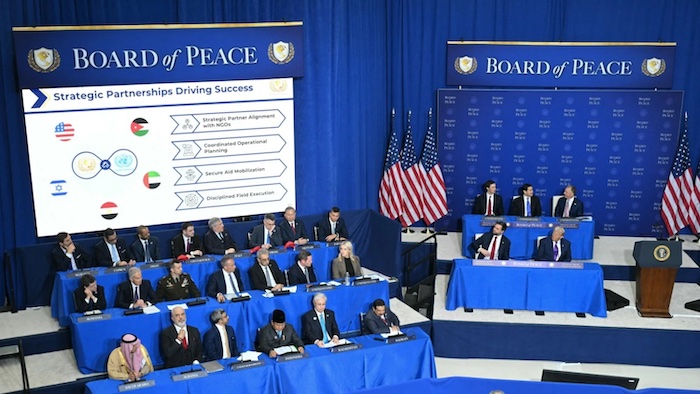
During the first meeting of his newly formed 'Board of Peace' in Washington, DC, Trump portrayed the initiative as a replacement for existing multilateral frameworks, hinting that it would "overlook" the United Nations to ensure effective management. The implications are significant: this endeavor extends beyond the mere rebuilding of Gaza; it aims to redefine the leadership in managing international crises.
The summit took place at the United States Institute for Peace, where Trump gathered influential regional powers, financial entities, and military allies, labeling the coalition a results-oriented partnership free from the constraints of traditional institutions.
For many years, the UN has served as the main arena for discussions regarding the Israeli-Palestinian conflict. Trump's Board of Peace represents a clear shift from that established paradigm towards a US-centered coalition that synergizes state actors, private investments, and military collaboration.
US Secretary of State Marco Rubio stated that current international structures have been ineffective in addressing a "unique crisis." Vice President JD Vance emphasized that assertive leadership, rather than consensus-based diplomacy, is vital for sustainable peace.
France has declined to join the initiative, raising concerns that the Board could undermine UN responsibilities. Meanwhile, the UK, Italy, and Germany sent observers to the meeting but opted not to join formally, citing constitutional and legal hurdles.
The sentiment from some European nations is cautious: they are open to reconstruction but insist that it must not compromise established international standards.
Trump committed $10 billion from the US and mentioned that over $7 billion has been pledged by partners from Gulf and Central Asia.
However, the framework of this initiative suggests a transformative shift. Ajay Banga has confirmed that the World Bank will act as a "limited trustee" responsible for managing donor contributions, while the Board of Peace will maintain strategic oversight. This hybrid model—public financing governed by a multilateral authority but steered by a political board—is unprecedented.
Marc Rowan of Apollo Global Management highlighted the Gaza shoreline's potential $50 billion worth, reinforcing Trump's continuous characterization of the area as an economic treasure waiting to be unlocked.
Essentially, the Board of Peace merges geopolitical strategies with investment opportunities, intertwining reconstruction efforts with market potential.
The suggested International Stabilization Force (ISF) further highlights the new operational framework. General Jasper Jeffers proposed a 20,000-member force, supported by 12,000 police trained locally.
Countries like Indonesia, Morocco, Kosovo, and Albania have reportedly committed to providing troops. Egypt and Jordan are expected to assist in police training, while Turkiye's foreign minister, Hakan Fidan, expressed willingness to deploy troops despite opposition from Israeli Prime Minister Benjamin Netanyahu.
Significantly absent from this arrangement is a UN mandate.
Experts caution that without a stable ceasefire or an accord with Hamas, troop deployment remains improbable. Nonetheless, the blueprint itself showcases Washington's readiness to design alternative security mechanisms beyond the conventional UN peacekeeping routes.
A Palestinian technocratic committee has been established to oversee daily operations in Gaza, but there remains an absence of Palestinian political representation on the broader Board structure.
During the summit, Sheikh Mohammed bin Abdulrahman bin Jassim Al Thani, Qatar's Prime Minister, was the sole senior dignitary to openly advocate for Palestinian statehood.
Israeli Foreign Minister Gideon Sa'ar commended the board for emphasizing disarmament and demilitarization, framing it as a strategy to tackle the "core of the issue."
The disparity highlights a significant tension: the board is focused on security, investments, and management, while pivotal political matters regarding final-status negotiations are sidelined.
Trump described the Board of Peace as a model that may be adapted to other "impossible" conflicts. Should it succeed, it could herald a transformative doctrine characterized by coalition-driven reconstruction led by US initiatives, private funding, and selective military coordination that operates adjacent to UN systems rather than within them.
Conversely, if it fails, it might exacerbate geopolitical divisions and foster skepticism towards unilateral action frameworks.
Comments (0)
You must be logged in to comment.
Be the first to comment on this article!