
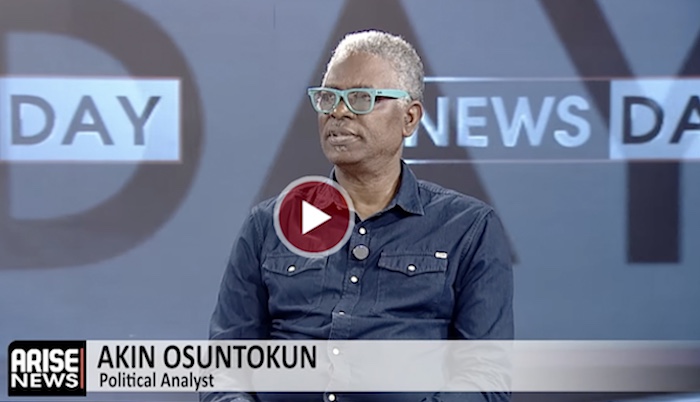
Akin Osuntokun, a notable political analyst, has expressed skepticism regarding the threats made by certain political parties to boycott upcoming elections, suggesting that such actions are unlikely to significantly affect the integrity or execution of the polls unless prominent parties partake in the boycott.
In an interview with ARISE News on Friday, Osuntokun remarked that the impact of the boycott threat issued by the Inter-Party Advisory Council (IPAC) hinges on the importance and influence of the parties involved.
He emphasized the importance of identifying which parties are part of the IPAC to assess the validity of the boycott threat.
"You need to ascertain which parties fall under the IPAC's framework. Only then can we evaluate the significance of their statements," he stated.
Osuntokun pointed out that well-known political entities in Nigeria do not necessarily belong to the coalition voicing the threat, raising questions about the prospective effectiveness of the proposed boycott.
"For example, more prominent parties are not under the IPAC. It is crucial to understand the number of parties associated with it," he elaborated.
He further indicated that even if certain parties choose not to participate in the elections, the government could still conduct the electoral process given the high number of registered political parties in the country.
"There are numerous political parties capable of sponsoring candidates for the elections, which would render the discussion moot," he concluded.
Osuntokun acknowledged that the absence of key political figures might lead to concerns about the election's validity. However, he noted that historically, boycotts have not proven to be a wise strategic move for political parties in Nigeria.
"Certainly, it raises credibility questions should influential parties abstain from the process," he remarked. "However, Nigeria has a history of debate on whether or not to boycott, and it seems unwise to choose that path during elections."
He also pointed out that complaints about the electoral laws appear to have arisen rather late, observing that political stakeholders had prior chances to voice their concerns.
"This has not been a covert development. The legislation was enacted, and the parties were aware of it," he continued.
Osuntokun added that although the grievances raised by political parties are legitimate, the success of such protests is contingent upon the political influence backing them.
"If I have a vision I want to manifest but lack the means to realize it, it ultimately proves useless," he explained.
In closing, he emphasized that Nigerian politics tends to mirror the realities of power dynamics instead of purely adhering to democratic ideals.
"What we refer to as real politics involves the exercise of power, and its fundamental goal is the acquisition of power," Osuntokun stated.
Comments (0)
You must be logged in to comment.
Be the first to comment on this article!