
Robert S. Mueller III, a former director of the Federal Bureau of Investigation (FBI) and notable figure behind the investigation into Russia's influence during the 2016 U.S. election, has died at the age of 81. His family announced his death on Friday, March 20, although they did not reveal the cause.
Mueller served as the FBI’s director for a continuous twelve years, beginning just days prior to the September 11 attacks. He played a pivotal role in transforming the bureau’s focus toward counterterrorism and intelligence to address emerging global challenges. His leadership was marked by significant structural reforms, enhancing collaboration with agencies such as the CIA and NSA, and increasing the utilization of surveillance capabilities under the laws enacted after 9/11.
In spite of the strong national security measures during his tenure, Mueller also faced resistance regarding controversial practices. Under his guidance, FBI agents raised alarms about potential abuses in CIA-operated secret detention facilities, including Abu Ghraib. He was involved in notable internal conflicts concerning a clandestine domestic surveillance program, leading to threats of resignation by him and senior Justice Department officials, citing potential violations of constitutional rights.
After leaving the FBI in 2013, Mueller returned to the public sphere in 2017, being appointed as a special counsel after Trump dismissed FBI Director James Comey. His investigation scrutinized possible connections between Trump's campaign and Russian actions that aimed to influence the electoral process.
Throughout the course of nearly two years, Mueller's investigation resulted in charges against various individuals, including campaign chair Paul Manafort, who received prison time, in addition to securing guilty pleas and convictions from several key associates like Michael Flynn and Roger Stone. The investigation also highlighted coordinated misinformation efforts undertaken by Russian entities, including the Internet Research Agency.
Mueller’s final report, issued in 2019, established that Russia had indeed interfered in the elections and that the Trump campaign anticipated benefiting from these efforts, though it did not find evidence of a criminal conspiracy. On the topic of obstruction of justice, Mueller noted that the investigation did not absolve the president of wrongdoing, even though it stopped short of concluding he committed a crime.
The publication of the report ignited significant political discourse, with former Attorney General William Barr's summary criticized for allegedly minimizing its findings. Trump consistently characterized the investigation as a “witch hunt.” Mueller, meanwhile, maintained a relatively low public profile, providing only limited congressional testimony and a brief defense of his team's work.
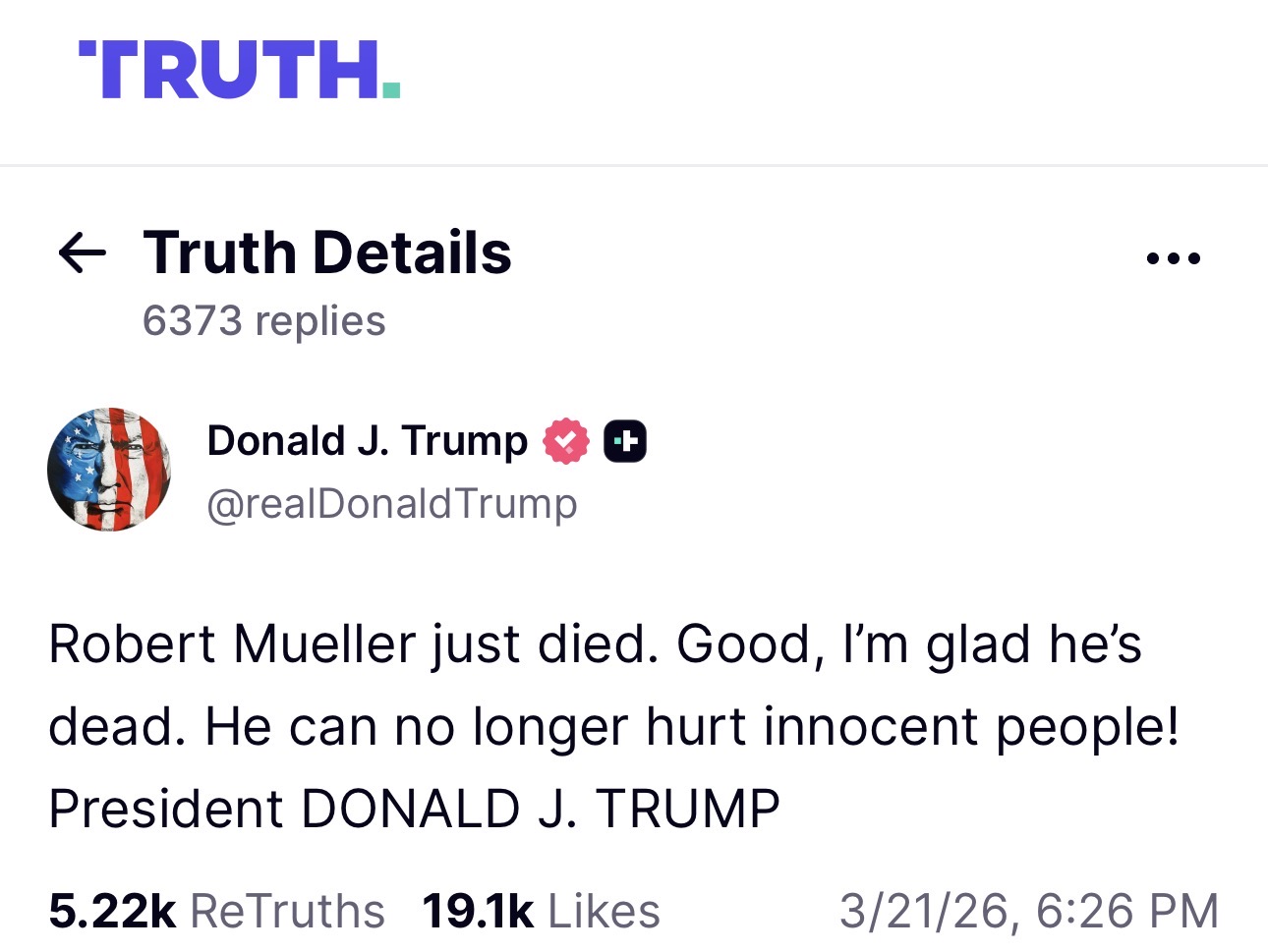
In response to the news of Mueller’s passing, Trump offered a critical commentary via social media, showcasing the lingering antagonism between the two figures. Trump posted, “Robert Mueller just died. Good, I’m glad he’s dead. He can no longer hurt innocent people!”
Beyond his later career, Mueller had a storied history of public service, having served as a Marine during the Vietnam War, where he received a Bronze Star for courage and a Purple Heart for injuries sustained in combat. He also earned respect as a tough federal prosecutor, overseeing significant cases like the investigation into the Lockerbie bombing.
Mueller’s impact is characterized by two major parts: the overhaul of the FBI post-9/11 and the leadership of one of the most politically significant investigations in contemporary U.S. history.
Comments (0)
You must be logged in to comment.
Be the first to comment on this article!